---
title: "How to Promote Your Hotel on Xiao Hong Shu (RED / REDnote): A Practical Guide for Malaysian Hoteliers"
description: Chinese travellers plan trips on Xiao Hong Shu (RED / REDnote) before they fly. Learn how Malaysian hotels can get discovered on the platform — and turn that traffic into commission-free direct bookings.
image: https://page.mysoftinn.com/hubfs/how-to-promote-your-hotel-on-rednote-xiaohongshu.png
---
[](https://www.mysoftinn.com)
- Products
- [Property Management System](https://www.mysoftinn.com/hotel-pms-front-desk-system)
- [Booking Engine](https://www.mysoftinn.com/hotel-booking-engine)
- [Hotel Website CMS](https://www.mysoftinn.com/hotel-website-cms)
- [Hotel Channel Manager](https://www.mysoftinn.com/hotel-channel-manager)
- [Hotel Kiosk](https://www.mysoftinn.com/hotel-kiosk)
- [AI New](https://www.mysoftinn.com/ai)
- Segments
- [Independent Boutique Hotel](https://www.mysoftinn.com/boutique-hotel-management-system)
- [Hotel Chains](https://www.mysoftinn.com/hotel-chain-management-system)
- [Resort & Villa](https://www.mysoftinn.com/resort-management-system)
- [Short-Term Vacation Rental](https://www.mysoftinn.com/airbnb-short-term-rental-property-management-software)
- [Campsite](https://www.mysoftinn.com/campsite-management-system)
- [Airport Hotel](https://www.mysoftinn.com/airport-hotel-management-system)
- Roles
- [Admin & Owner](https://www.mysoftinn.com/hotel-owner)
- [Manager](https://www.mysoftinn.com/hotel-manager)
- [Front Desk](https://www.mysoftinn.com/hotel-front-desk-receptionist)
- [Housekeeping](https://www.mysoftinn.com/hotel-housekeeper)
- [Maintenance](https://www.mysoftinn.com/hotel-maintenance-technician)
- [Finance](https://www.mysoftinn.com/hotel-finance-accountant)
- [Marketing and Sales](https://www.mysoftinn.com/hotel-marketing-sales)
- Resources
- [Knowledge Base](https://blog.mysoftinn.com)
- [E-books](https://page.mysoftinn.com/guide-and-resources?hsLang=en-my)
- [Product Training](https://page.mysoftinn.com/softinn-product-training-session?hsLang=en-my)
- [Blog & Articles](https://page.mysoftinn.com/en)
- [Product Updates](https://blog.mysoftinn.com/category/product-updates/)
- [Partner & Integration](https://www.mysoftinn.com/integrations)
- Company
- [About Softinn](https://www.mysoftinn.com/about-us)
- [Contact Us](https://www.mysoftinn.com/contact-us)
- [Careers](https://page.mysoftinn.com/careers?hsLang=en-my)
- [Pricing](https://www.mysoftinn.com/pricing)
[Free Trial](https://page.mysoftinn.com/softinn-signup-form?hsLang=en-my) [Login](https://www.mysoftinn.com/login)
Direct Booking Direct Booking Path Direct Booking Path Traffic
# How to Promote Your Hotel on Xiao Hong Shu (RED / REDnote): A Practical Guide for Malaysian Hoteliers
JeeShen
Last updated 30 Jun 2026
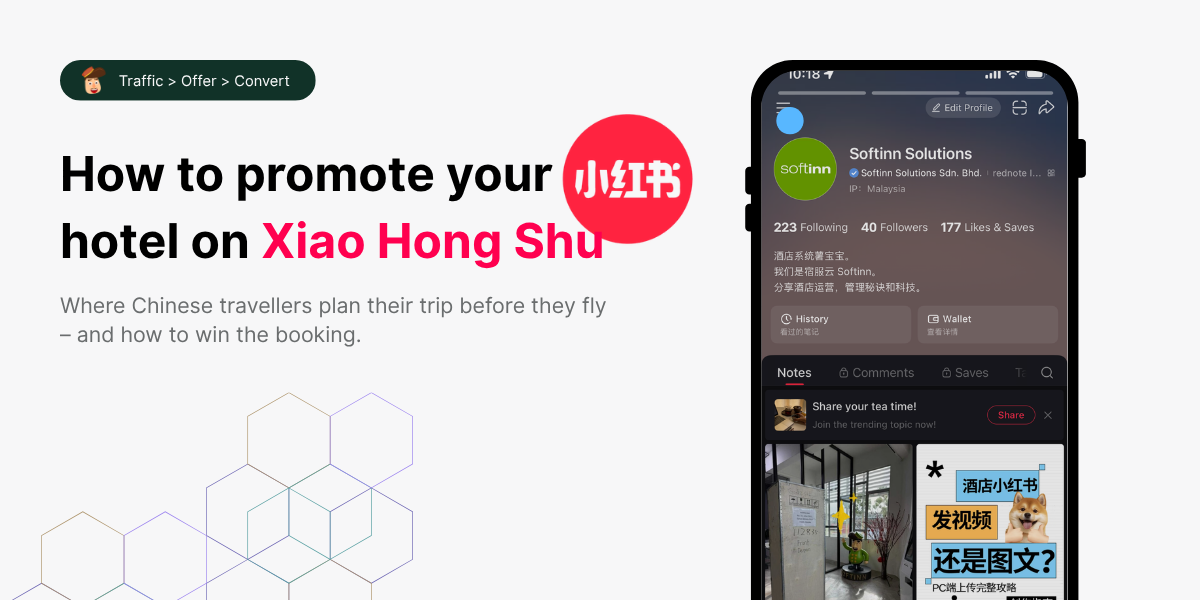
Picture this. A young woman in Shanghai is planning her first trip to Malaysia. She doesn't open Google. She doesn't go straight to Booking.com. She opens an app called Xiao Hong Shu and types "马来西亚酒店" (Malaysia hotel). Within seconds she's scrolling through real photos, honest reviews, and room tours posted by people like her. By the time she books, she has already decided where she's staying.
If your hotel isn't in those search results, you don't exist to her. And there are millions of her.
## The problem: your future guests are searching a platform you're probably not on
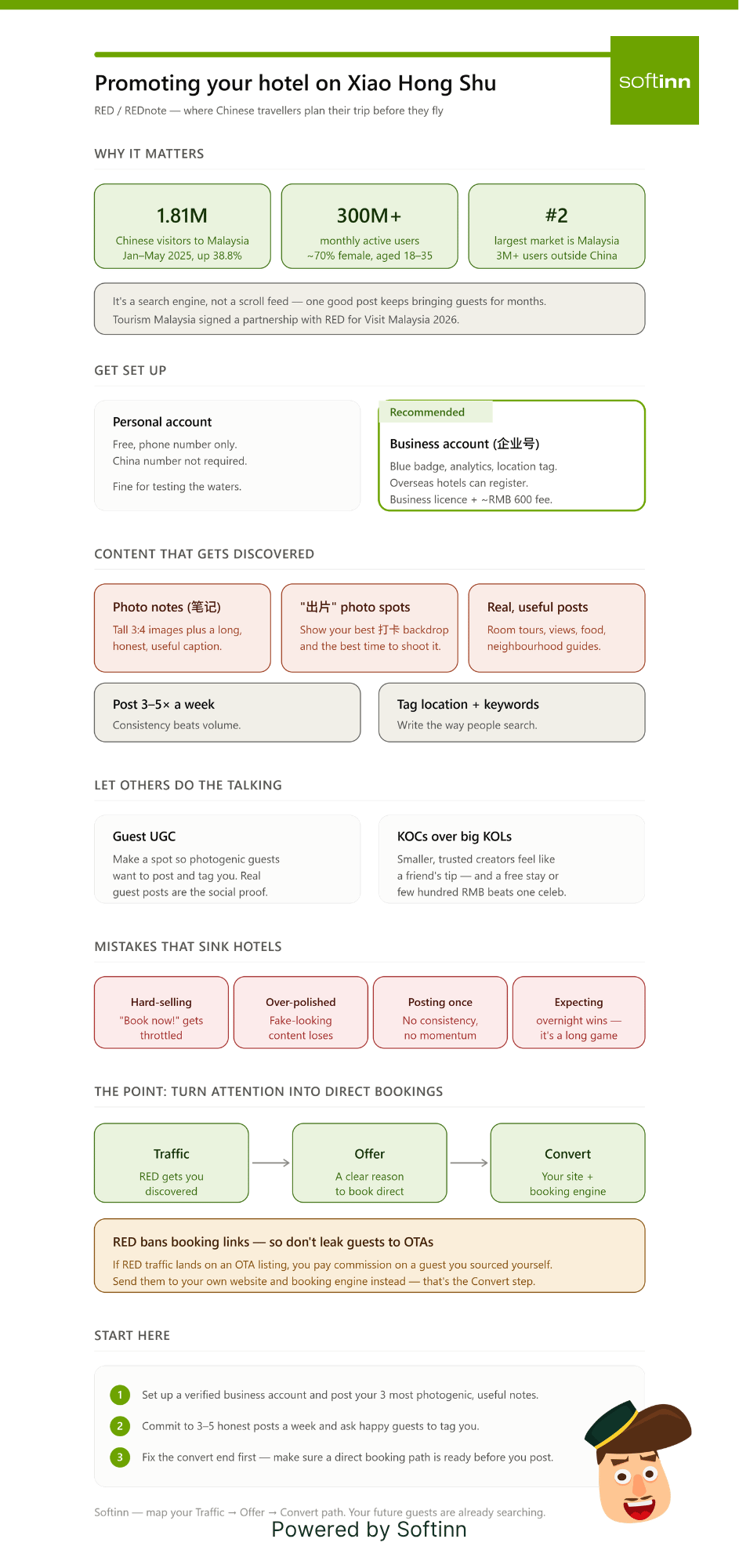
Chinese travellers are flooding back into Malaysia. Between January and May 2025, Malaysia welcomed about 1.81 million visitors from China — up 38.8% year-on-year, the fastest growth of any key market, according to Tourism Minister Datuk Seri Tiong King Sing's written parliamentary reply. China is now Malaysia's second-largest source market after Singapore, and these guests tend to stay longer and spend more — Hong Leong Investment Bank put average spend at around RM4,300 per visitor in Q1 2025. [The Edge Malaysia + 3](https://theedgemalaysia.com/node/763490)
Here's the part most hoteliers miss: before they fly, these travellers plan their entire trip on Xiao Hong Shu (小红书), known internationally as RED or REDnote. The platform has over 300 million monthly active users. Its audience skews heavily female (around 70%) and young (most are aged 18–35), concentrated in China's wealthier first- and second-tier cities. And it's not only big in China — with over 3 million monthly active users, Malaysia is now Xiao Hong Shu's second-largest market outside the mainland. [Statista + 3](https://www.statista.com/topics/13129/xiaohongshu-rednote/)
This isn't hype. On 28 May 2025, Tourism Malaysia signed a Memorandum of Collaboration with Xiao Hong Shu (REDBOOK Holdings) to promote Visit Malaysia 2026 to Chinese travellers. As Director-General Datuk Manoharan Periasamy put it, "Malaysia has been consistently trending on Xiaohongshu as one of the most searched and talked-about destinations among Chinese users." The national tourism body is betting on this platform. The question is whether you are. [LinkedIn](https://www.linkedin.com/posts/marketinginteractive_tourism-malaysia-has-signed-a-strategic-memorandum-activity-7339139468915896320-Mppd)
[Marketing-Interactive](https://www.marketing-interactive.com/tourism-malaysia-partners-xiaohongshu-to-boost-chinese-arrivals)
## Why this matters for your business
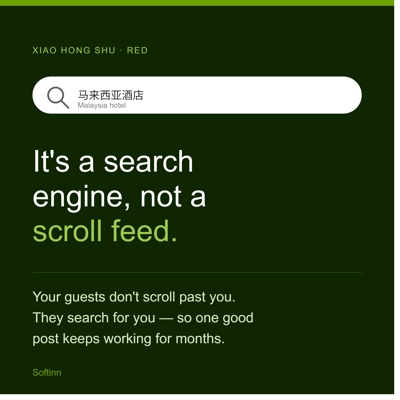
Xiao Hong Shu is not "another Instagram." Treating it like one is exactly why most hotels fail on it.
Two things make it fundamentally different:
**1. It's a search engine, not a scroll feed.** Users go to the search bar with intent. They search "槟城亲子酒店" (Penang family hotel) or "吉隆坡 出片 酒店" (KL photogenic hotel) the same way you'd Google something. The platform handles enormous search volume — reportedly around 600 million searches a day. This means a good post you publish today can keep bringing you guests for *months* — unlike a Facebook post that dies in a day.
[WJBF](https://www.wjbf.com/business/press-releases/ein-presswire/836511143/chinese-platform-xiaohongshu-hits-300m-users-delivers-21-4-conversion-rates-for-global-brands/)
**2. It runs on trust, not ads.** Users come for honest, detailed reviews from real people. The community is very good at spotting polished marketing — and the algorithm quietly buries content that feels like an advertisement or makes exaggerated claims. [Hashmeta](https://hashmeta.com/blog/xiaohongshu-for-tourism-hotels-in-malaysia-complete-marketing-guide/)
[Hashmeta](https://hashmeta.com/blog/xiaohongshu-for-hotels-complete-guide-to-tourism-marketing-in-china/)
For a small or independent hotel, this is genuinely good news. The algorithm rewards helpful content over big budgets, so a 30-room boutique hotel in Ipoh can out-rank a chain if its content is more useful. [Hashmeta](https://hashmeta.com/blog/xiaohongshu-for-tourism-hotels-in-malaysia-complete-marketing-guide/)
## Getting set up: your account
You have two options:
- **Personal account:** Free. Anyone can register with a phone number (a China number is *not* required). Fine for testing the waters. [WSD](https://www.wsdsocial.com/en-us/article/xiaohongshu-account-registration-2026-en)
- **Business / "Professional" account (企业号):** This gets you the blue "V" badge, analytics, and the ability to add your hotel as a searchable location. Overseas businesses, including Malaysian hotels, can register. You'll typically need your business licence (often with a Chinese translation), a verification fee of around RMB 600, and a few business days for review. Hotels can usually upgrade directly to a Pro account.
Get the business account. The credibility badge and the location tag matter — when a guest reads a great post about your hotel, they should be able to tap the location and land on your verified profile.
Getting a business account will remove interaction restrictions. You're allowed to share links and interact with your followers for business transactions (e.g. bookings). Busines account will be indicated with the "blue tick".
> 2026-Jun: Rednote has rolled out the international version of their content dashboard for content creators. It features an English user interface.
## What actually works: content that gets you discovered
Forget glossy hero shots of your lobby. On Xiao Hong Shu, the content that performs is *useful and real*.
**Photo "notes" (笔记) are the backbone.** These are image posts — best shot in a tall 3:4 frame — paired with a detailed written caption. Unlike a one-line Instagram caption, good Xiao Hong Shu captions are long and genuinely informative: room sizes in real terms, what's nearby, whether breakfast suits Chinese tastes, how easy check-in is, and honest prices. [Hashmeta](https://hashmeta.com/blog/xiaohongshu-for-tourism-hotels-in-malaysia-complete-marketing-guide/)
[Digital Crew](https://www.digitalcrew.agency/xiaohongshu-marketing-for-tourism-and-hospitality-brands/)
**Lean into "出片" (chū piān) — photogenic spots.** Chinese travel culture revolves around 打卡 (dǎ kǎ), or "checking in" at a place and posting the proof. Travellers actively search for backdrops that photograph beautifully. If your hotel has a stunning pool, a sunrise-facing balcony, a pretty café corner, or a great view — that's your hook. Show the exact spot and the best time of day to shoot it.
**Content ideas that consistently work for hotels:**
- First-person room tours (show the real layout, not just flattering angles)
- The actual view from each room category
- Neighbourhood guides — the good coffee shop, the night market, the 10-minute walk to the beach [Digital Crew](https://www.digitalcrew.agency/xiaohongshu-marketing-for-tourism-and-hospitality-brands/)
- Food: breakfast spreads, nearby halal options, supper spots open after 9pm
- Honest, practical tips that answer real traveller worries
**Posting rhythm:** consistency beats volume. Aim for around 3–5 posts a week, every week. The algorithm rewards steady activity and loses interest in stop-start accounts. [GMA](https://chinesetouristagency.com/a-must-have-in-china-a-xiaohongshu-account-for-my-hotel/)
**Use location tags and keywords properly.** Tag your hotel's location on every post, and write the way users actually search — specific phrases like "Langkawi beachfront hotel" in Chinese, not vague slogans. Use a handful of relevant hashtags (five to ten is plenty).
## Let other people do the talking: UGC and influencers
The most powerful content isn't from your account — it's from guests and creators.
**Encourage guest UGC.** Make a spot in your hotel so photogenic that guests *want* to post it. A small in-room card inviting them to tag your location, or a little welcome gift, goes a long way. Real guest posts are the social proof that converts. [Deep Digital China](https://www.deepdigitalchina.com/how-to-successfully-market-travel-on-xiaohongshu/)
**Work with KOCs, not just famous KOLs.** A KOL (Key Opinion Leader) is a big influencer; a KOC (Key Opinion Consumer) is a regular user with a smaller but trusted following. For most hotels under 150 rooms, KOCs are the smart play. They're affordable — often a free stay or roughly a few hundred to a few thousand RMB per post — and their recommendations feel like a friend's tip, not an ad. Host a few, give them a genuinely good stay, and let them post honestly. Several smaller, authentic collaborations beat one expensive celebrity post.
## The mistakes that sink hotels
- **Treating it like a billboard.** Hard-selling and "Book now! Best price!" content gets throttled. Share experiences, don't shout offers.
- **Over-polished, fake-looking content.** Authenticity wins. Show the real room.
- **Posting once and disappearing.** No consistency, no momentum.
- **Expecting overnight results.** This is a long game — you're building a library of searchable content and a base of real reviews. It compounds over months, not days.
## The opinionated bit: traffic is worthless if you can't convert it
Here's where most hotels go wrong, and it's the most important point in this whole article.
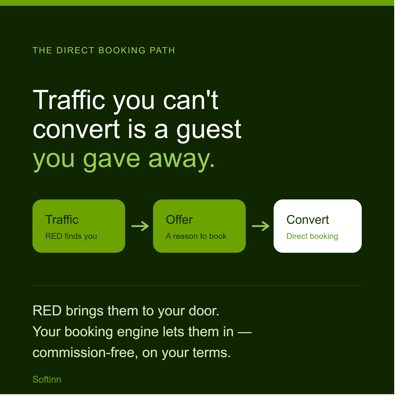
Getting discovered on Xiao Hong Shu is **Traffic** — the top of the funnel. But traffic alone doesn't pay your bills. At Softinn we think about direct bookings as a simple path: **Traffic → Offer → Convert.** Xiao Hong Shu is a brilliant traffic source. But if you have no clear offer and no way to convert, that attention just leaks away.
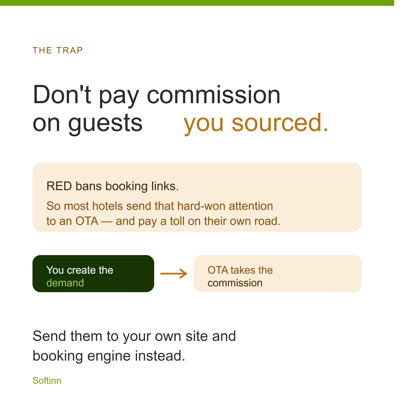
And here's the trap specific to this platform: Xiao Hong Shu is a closed garden. You **cannot** drop a booking link into your posts — external links and contact details get your content suppressed or removed. So what do most hotels do? They let that hard-won attention drift to an OTA listing. Think about what that means: you did the marketing, you created the content, you earned the guest's trust — and then you hand them to Booking.com or Agoda and pay commission on a guest *you* sourced yourself. That's paying a toll on your own road. [Halo Tech Media](https://halotechmedia.sg/blog/xhs-business-account/)
The smarter play is to turn that attention into **direct bookings**. When a guest discovers you on RED and then searches your hotel name, what they find next decides everything. They should land on your own website with a proper booking engine — not just an OTA page.
That's the **Convert** step, and it's exactly the gap Softinn is built to close. A clean hotel website (Website CMS) plus a commission-free Booking Engine means the demand you create on Xiao Hong Shu turns into bookings *you* own — with the guest's details, no middleman, and no commission. RED brings them to your door; your booking engine lets them in. [Software Advice](https://www.softwareadvice.com/hotel-management/softinn-hotel-booking-engine-profile/)
## Your practical takeaway
Don't think of Xiao Hong Shu as "a social media account someone should manage." Think of it as the front of a path that ends in a direct booking. Here's where to start:
1. **This month:** Set up a verified business account and add your hotel as a location. Post your three most photogenic, most useful "notes."
2. **Build the habit:** Commit to 3–5 honest, helpful posts a week. Encourage every happy guest to post and tag you.
3. **Fix the conversion end first:** Make sure that when RED traffic searches your hotel, they find a proper website and a direct booking engine waiting — not just an OTA listing eating your margin.
Chinese travellers are coming to Malaysia in record numbers, and they're choosing their hotels on Xiao Hong Shu. You can absolutely earn that attention. Just make sure you've built the path to capture it — because traffic you can't convert is a guest you paid for and then gave away.
If you're not sure your "convert" step is ready, that's the place to start. Map your own Traffic → Offer → Convert path before you post — your future guests are already searching.
[](http://www.facebook.com/share.php?u=https%3A%2F%2Fpage.mysoftinn.com%2Fen%2Fhow-to-promote-your-hotel-on-xiao-hong-shu-red-%2F-rednote-a-practical-guide-for-malaysian-hoteliers%3Futm_medium%3Dsocial%26utm_source%3Dfacebook) [](http://www.linkedin.com/shareArticle?mini=true&url=https%3A%2F%2Fpage.mysoftinn.com%2Fen%2Fhow-to-promote-your-hotel-on-xiao-hong-shu-red-%2F-rednote-a-practical-guide-for-malaysian-hoteliers%3Futm_medium%3Dsocial%26utm_source%3Dlinkedin) [](https://twitter.com/intent/tweet?original_referer=https%3A%2F%2Fpage.mysoftinn.com%2Fen%2Fhow-to-promote-your-hotel-on-xiao-hong-shu-red-%2F-rednote-a-practical-guide-for-malaysian-hoteliers%3Futm_medium%3Dsocial%26utm_source%3Dtwitter&url=https%3A%2F%2Fpage.mysoftinn.com%2Fen%2Fhow-to-promote-your-hotel-on-xiao-hong-shu-red-%2F-rednote-a-practical-guide-for-malaysian-hoteliers%3Futm_medium%3Dsocial%26utm_source%3Dtwitter&source=tweetbutton&text=) [](http://pinterest.com/pin/create/button/?url=https%3A%2F%2Fpage.mysoftinn.com%2Fen%2Fhow-to-promote-your-hotel-on-xiao-hong-shu-red-%2F-rednote-a-practical-guide-for-malaysian-hoteliers%3Futm_medium%3Dsocial%26utm_source%3Dpinterest&media=) [](mailto:?subject=Check%20out%20https%3A%2F%2Fpage.mysoftinn.com%2Fen%2Fhow-to-promote-your-hotel-on-xiao-hong-shu-red-%2F-rednote-a-practical-guide-for-malaysian-hoteliers%3Futm_medium%3Dsocial%26utm_source%3Demail%20&body=Check%20out%20https%3A%2F%2Fpage.mysoftinn.com%2Fen%2Fhow-to-promote-your-hotel-on-xiao-hong-shu-red-%2F-rednote-a-practical-guide-for-malaysian-hoteliers%3Futm_medium%3Dsocial%26utm_source%3Demail)
##### Tags
[Direct Booking](https://page.mysoftinn.com/en/tag/direct-booking) [Direct Booking Path](https://page.mysoftinn.com/en/tag/direct-booking-path) [Direct Booking Path Traffic](https://page.mysoftinn.com/en/tag/direct-booking-path-traffic)

##### JeeShen
JeeShen is the CEO of Softinn, a SaaS company helping hotels run smoother and smarter. He’s not a professional blogger—just a tech and hospitality enthusiast who loves sharing thoughts, insights, and a few stories from the frontlines of the industry.
#### Stay in the Loop!
Get the latest hotel management insights, tips, and industry updates delivered to your inbox monthly. No spam, just valuable content.
- Monthly expert insights
- Industry trends & best practices
- Exclusive tips & resources
[Subscribe Now](https://page.mysoftinn.com/softinn-blog-subscription?hsLang=en-my) We respect your privacy. Unsubscribe anytime.
#### Comments
##### Recent Posts
[](https://page.mysoftinn.com/en/when-the-minimum-wage-goes-up-whats-your-hotels-next-move?hsLang=en-my)
###### [When the Minimum Wage Goes Up, What's Your Hotel's Next Move?](https://page.mysoftinn.com/en/when-the-minimum-wage-goes-up-whats-your-hotels-next-move?hsLang=en-my)
[](https://page.mysoftinn.com/en/why-hotels-should-offer-reserve-now-pay-later-to-guests?hsLang=en-my)
###### [Why Hotels Should Offer Reserve Now, Pay Later to Guests](https://page.mysoftinn.com/en/why-hotels-should-offer-reserve-now-pay-later-to-guests?hsLang=en-my)
[](https://page.mysoftinn.com/en/api-ai-integration-should-your-hotel-build-or-buy?hsLang=en-my)
###### [API, AI, Integration: Should Your Hotel Build or Buy?](https://page.mysoftinn.com/en/api-ai-integration-should-your-hotel-build-or-buy?hsLang=en-my)
[](https://page.mysoftinn.com/en/the-best-ai-preparation-your-hotel-can-do-has-nothing-to-do-with-ai?hsLang=en-my)
###### [The Best AI Preparation Your Hotel Can Do Has Nothing to Do With AI](https://page.mysoftinn.com/en/the-best-ai-preparation-your-hotel-can-do-has-nothing-to-do-with-ai?hsLang=en-my)
[](https://page.mysoftinn.com/en/the-e-invoice-exemption-increased-to-rm3million-what-it-means-for-your-hotel?hsLang=en-my)
###### [The e-Invoice Exemption Increased to RM3Million : What It Means For Your Hotel?](https://page.mysoftinn.com/en/the-e-invoice-exemption-increased-to-rm3million-what-it-means-for-your-hotel?hsLang=en-my)
# Get Your Free Trial Now!
[Start Trial](https://page.mysoftinn.com/softinn-signup-form?hsLang=en-my)
No credit card required
#### Products
[Property Management System](https://www.mysoftinn.com/hotel-pms-front-desk-system) [Hotel Channel Manager](https://www.mysoftinn.com/hotel-channel-manager) [Booking Engine](https://www.mysoftinn.com/hotel-booking-engine) [AI](https://www.mysoftinn.com/ai) [Hotel Website CMS](https://www.mysoftinn.com/hotel-website-cms) [Hotel Kiosk](https://www.mysoftinn.com/hotel-kiosk) [Softinn API](https://api.mysoftinn.com/swagger/ui/index) [Pricing & Plans](https://www.mysoftinn.com/pricing)
#### Segments
[Independent Boutique Hotel](https://www.mysoftinn.com/boutique-hotel-management-system) [Resort & Villa](https://www.mysoftinn.com/resort-management-system) [Hotel Chains](https://www.mysoftinn.com/hotel-chain-management-system) [Short-Term Vacation Rental](https://www.mysoftinn.com/airbnb-short-term-rental-property-management-software) [Campsite](https://www.mysoftinn.com/campsite-management-system) [Airport Hotel](https://www.mysoftinn.com/airport-hotel-management-system) [Customer Success Stories](https://www.mysoftinn.com/hotel-clients)
#### Resources
[Knowledge Base](https://blog.mysoftinn.com) [Blog & Articles](https://page.mysoftinn.com/en) [Product Updates](https://blog.mysoftinn.com/category/product-updates/) [Product Training](https://page.mysoftinn.com/softinn-product-training-session?hsLang=en-my) [Partner & Integration](https://www.mysoftinn.com/integrations)
#### Company
[About Softinn](https://www.mysoftinn.com/about-us) [Contact Us](https://www.mysoftinn.com/contact-us) [Careers](https://page.mysoftinn.com/careers?hsLang=en-my) [Press Kit](https://page.mysoftinn.com/hubfs/Softinn%20Press%20Kit%202025.pdf?hsLang=en-my)
[Terms of Service](https://page.mysoftinn.com/terms-of-service?hsLang=en-my)|[Privacy Policy](https://page.mysoftinn.com/privacy-policy?hsLang=en-my)
Softinn builds the next-generation hotel management system for hotels in Southeast Asia.
[](https://www.facebook.com/mySoftinn) [](https://www.linkedin.com/company/softinn) [](https://x.com/mysoftinn) [](https://www.youtube.com/c/Softinn) [](https://www.instagram.com/mysoftinn/)
---
© 2013-2026 Softinn Solutions Sdn. Bhd. 201201044886 (1029363-M). TIN: C-23412633070. SST No: M10-2208-32100003. All rights reserved.
Made with ♥ in Malacca, Malaysia.

```json
{
"@context" : "https://schema.org",
"@type" : "BlogPosting",
"author" : {
"@type" : "Person",
"name" : "JeeShen",
"url" : "https://page.mysoftinn.com/en/author/jeeshen"
},
"dateModified" : "2026-06-30T03:07:28.358Z",
"datePublished" : "2026-06-30T03:07:28.000Z",
"headline" : "How to Promote Your Hotel on Xiao Hong Shu (RED / REDnote): A Practical Guide for Malaysian Hoteliers",
"image" : [ "https://page.mysoftinn.com/hubfs/how-to-promote-your-hotel-on-rednote-xiaohongshu.png" ],
"mainEntityOfPage" : {
"@id" : "https://page.mysoftinn.com/en/how-to-promote-your-hotel-on-xiao-hong-shu-red-/-rednote-a-practical-guide-for-malaysian-hoteliers",
"@type" : "WebPage"
},
"publisher" : {
"@type" : "Organization",
"logo" : {
"@type" : "ImageObject",
"url" : "https://page.mysoftinn.com/hubfs/230813-softinn-block-green.png"
},
"name" : "Softinn Solutions Sdn. Bhd."
}
}
```
```json
{
"@context" : "https://schema.org",
"@type" : "VideoObject",
"contentUrl" : "https://2834426.fs1.hubspotusercontent-na2.net/hubfs/2834426/video_assets/363239085787/inherited/web_optimized.mp4",
"dateModified" : "2026-06-30T03:06:17.954Z",
"duration" : "PT49S",
"height" : 2532,
"name" : "26-06-30-01-Rednote",
"thumbnailUrl" : "https://page.mysoftinn.com/hubfs/26-06-30-01-Rednote.mp4/medium.jpg",
"uploadDate" : "2026-06-30T03:05:46.171Z",
"width" : 1170
}
```