
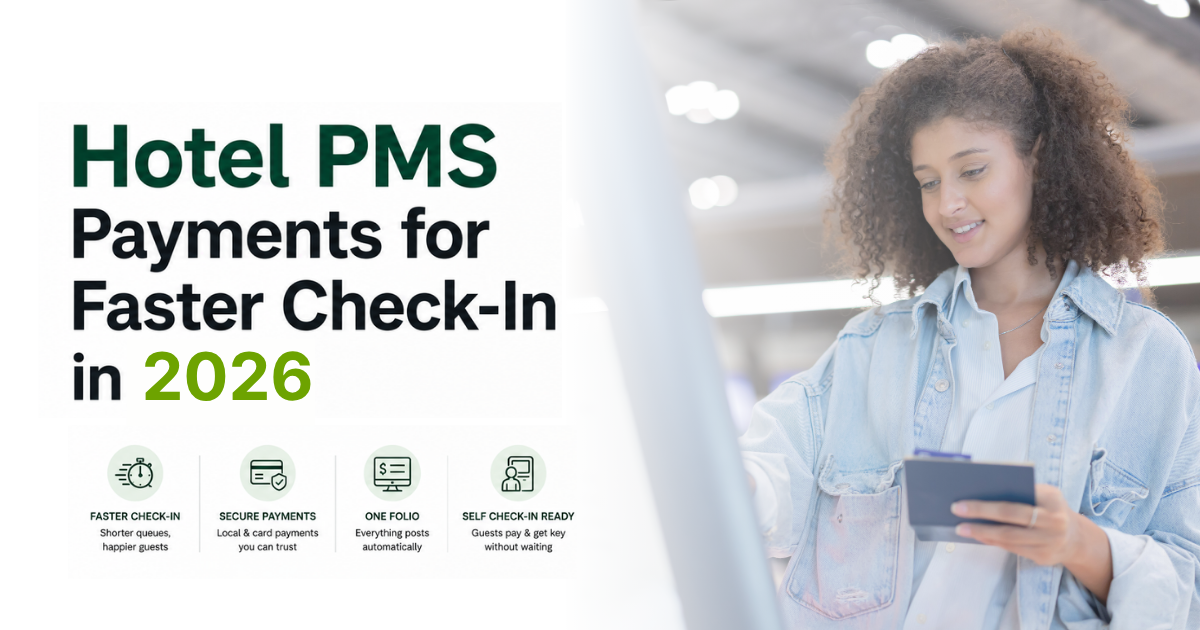
Payment is usually the slowest step at arrival. The fix is closing the gap between the money and the booking record, so payment becomes part of check-in rather than a separate job done beside it. Let Your Booking Engine (BE) collects payment before the guest arrives. Your PMS settles whatever is left at the desk and posts it straight to the folio. The built-in payment gateway is what ties them, and the kiosk, into one flow.
Check-in gets faster when your Booking Engine collects most of the money before arrival, your PMS settles the rest in one tap without re-keying, guests pay with methods they already trust, and the whole flow can move to a self-check-in kiosk that skips the desk entirely. The rest of this guide breaks that down. If you want the separate topic of in-stay charges like room service and late checkout posting to the folio during the stay, see our companion piece on the hotel PMS with a built-in payment gateway.
What can you collect before the guest even arrives?
When a guest books direct on your website, your booking engine can collect full payment or a deposit at that moment, before they ever reach the lobby. That is a separate payment moment from the desk, and it does two jobs:
-
It confirms the booking
-
Reduces no-shows
The more you collect cleanly up front, the lighter the desk. A guest who has prepaid walks in already halfway checked in.
What still needs to be collected at check-in?
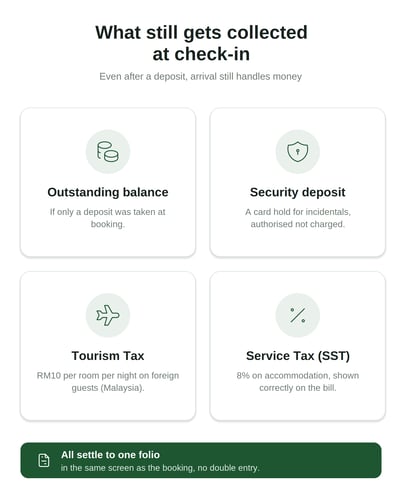
Even with a deposit taken, the arrival desk still handles money, and in this region it is more than just a room balance:
- The outstanding balance, if only a deposit was taken at booking.
- A security deposit or card authorisation for incidentals, held rather than charged.
- Tourism Tax, a fixed RM10 per room per night on foreign guests in Malaysia. For direct and walk-in bookings you collect this at the desk. Note that since the online-platform grace period ended on 31 December 2025, OTAs now collect Tourism Tax at the point of booking, so the desk mainly handles it for the bookings you own.
- Service Tax (SST) at 8% on accommodation, which needs to be shown correctly on the guest's bill.
When the gateway is built into the property management system, each of these is settled from the same screen as the reservation, and each posts straight to the folio. No re-keying, no side calculation, no receipt to chase later. Read also: Special Tax Incentive for Hotel: Malaysia Budget 2026.
How do PMS payments make check-in faster?
Most of the money is already collected.
When a guest books direct, your Booking Engine can take a deposit or full payment at that moment. They arrive already paid, so the desk has little or nothing left to settle. The fastest check-in payment is the one that happened days ago.
What is left posts straight to the folio.
With a built-in gateway, the amount owed flows from the reservation to the payment and back to the booking on its own. Nobody reads a total off one screen and keys it into a separate terminal, and nobody reconciles it by hand afterwards. That removed step is where most of the speed comes from. Balance, deposit and any taxes all land in the same record.
Guests pay the way they already pay.
Digital payment is now the default across the region: in Malaysia, DuitNow QR and FPX online banking are everyday rails, and cross-border QR links are expanding fast. When your payment screen offers the rails they already use, FPX and DuitNow QR here, QRIS in Indonesia, PromptPay in Thailand, alongside cards, there is no hesitation at the counter and no counting cash or making change.
Deposits and holds are handled in the same flow.
A card pre-authorisation or a security deposit is taken digitally against the same booking, not with a manual imprint or a cash float. It releases against the same record, so there is nothing to track on a separate slip.
The desk sees it all on one screen.
Paid, outstanding, deposit held: the front desk reads payment status in the same place as the booking, with no separate bank app to open. Handover is quicker and there are fewer billing surprises later.
Free resource: The Ultimate Guide to Hotel Payment Gateway. Compare the payment rails available to Malaysian and Southeast Asian hotels, understand the fees, and pick the setup that keeps your check-in moving. Download the guide here.
How does a self check-in kiosk take the desk out of the equation?
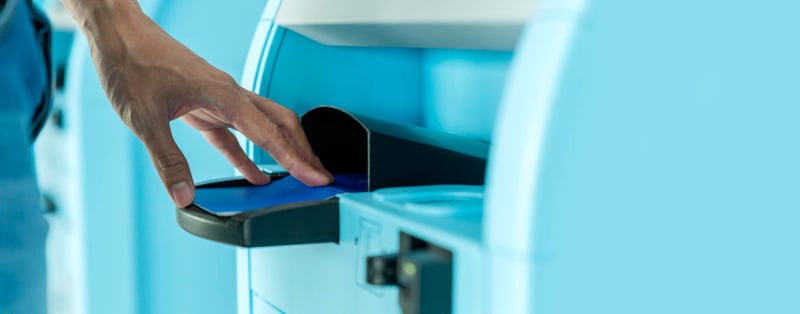
A self check-in kiosk lets the guest confirm their booking, settle whatever is owed, and collect a key without waiting for staff at all.
For this to work, payment and hardware have to move together. In Softinn's setup, the FATboy kiosk client connects the counter hardware to the same flow, linking the payment terminal and the door lock so the guest goes from paying to holding a key in one uninterrupted step. It is the same payment configuration as the front desk, not a second system to maintain, which matters when your team is small.
This is especially useful for late arrivals, when the desk may be lightly staffed but a guest still expects to get into their room without a wait.
How much time does faster check-in actually save?

The mechanical saving is obvious once payment stops being a two-system job. The bigger number is what happens to the queue.
Across our own network of independent hotels, self check-in has reduced front desk queues by up to 65.7%. That is time your team gets back, and it lands exactly where a small hotel feels the pressure most: the arrival rush, when several guests turn up at once, and one slow payment holds up everyone behind it.
If you are not sure whether your desk has this problem, our post on how to spot front desk delays before PMS adoption is a good place to start.
The practical takeaway
To make check-in faster, take as much payment as you can before arrival with your Booking Engine, let whatever is left settle to one folio at the desk or a kiosk through the PMS, and give the front desk one screen that shows what is paid. That is what turns arrival from a queue into a walk-through. Begin with the rails and the fees. Our Ultimate Guide to Hotel Payment Gateway walks you through the options for free.
Frequently asked questions
-
Does the PMS collect the online booking payment, or the Booking Engine?
-
The Booking Engine collects payment when a guest books direct on your website, before arrival. The PMS settles the remaining balance and any taxes at the desk and posts them to the folio. The built-in gateway connects the two so nothing is re-keyed.
-
-
What taxes does the desk still collect at check-in in Malaysia?
-
The room balance (if only a deposit was taken), any security deposit or card hold, SST at 8% on accommodation, and Tourism Tax of RM10 per room per night for foreign guests. For OTA bookings the platform now collects Tourism Tax at booking; the desk mainly handles it for direct and walk-in guests.
-
-
Do I need a kiosk to get faster check-in?
-
No. Most of the speed comes from collecting payment before arrival and settling the rest to one folio. A self-check-in kiosk (Softinn's FATboy) removes the desk step entirely and is most useful for arrival rushes and late, lightly staffed arrivals.
-


Tai Pei Shi
Hi, I am Pei Shi. I am a Technopreneurship student and digital marketing intern in Softinn.
Comments
Recent Posts
Google AI Mode for Hotels: What Hotel Owners Need to Know
When the Minimum Wage Goes Up, What's Your Hotel's Next Move?
Why Hotels Should Offer Reserve Now, Pay Later to Guests
API, AI, Integration: Should Your Hotel Build or Buy?
The Best AI Preparation Your Hotel Can Do Has Nothing to Do With AI