
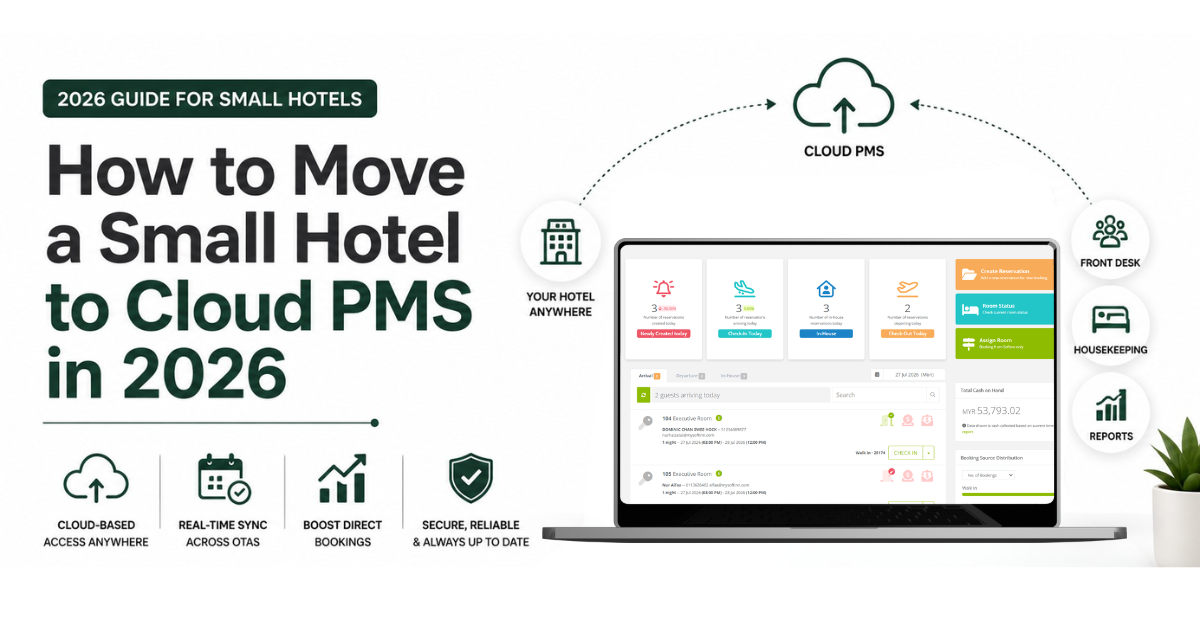
Quick answer: Moving a small hotel to a cloud-based hotel management system takes about four to eight weeks. You clean your data, map your daily workflows, pick a system that fits your property, reconnect your OTAs, run the old and new systems side by side for a day or two, then switch over in a quiet period. If you still run your front desk on a spreadsheet, a paper logbook, or an ageing back-office server, 2026 is a good time to make the move. Across Southeast Asia, cloud property management software has become the normal way small hotels run. This guide covers what it costs, how the move works, and what changes once you go live.
What is a cloud-based hotel management system?
A cloud PMS is hotel software that lives online instead of on a machine inside your property. You log in from any device with internet to manage bookings, check-ins, housekeeping, rates, and reports.
The difference from a legacy on-premise system is simple. On-premise needs a server, hardware upkeep, and someone to run updates. A cloud PMS handles hosting, backups, and updates for you, and you pay a monthly subscription instead of a large one-time licence. For a small team, that removes a lot of hidden work.
Why are small hotels in Southeast Asia moving to the cloud?
Asia-Pacific is the fastest-growing PMS market, driven by small and mid-sized hotels going digital, and many operators here skip on-premise entirely for mobile-first cloud systems.
But the sharper pressure is distribution cost. In Malaysia, OTAs held about 57.35% of hotel bookings in 2025. The true cost of that reliance runs higher than the headline: hotels here can pay up to 28% in total OTA fees once hidden costs stack on top of commission. Direct bookings, by contrast, carry 9 to 20% higher margins.
Here is where our own numbers matter more than any market report. Across Softinn's hotels, 43.52% already run with little to no OTA reliance, and 56.94% use a booking engine to take reservations directly. That balance is not just for the big chains. It is what a well-run small property already looks like today.
A cloud PMS is what lets a small hotel manage that balance. It keeps your rates and availability in sync across your OTAs in real time, and it integrates with a booking engine so you can win back direct bookings instead of paying commission on every stay.
I believe the cloud-versus-on-premise debate is over for hotels under 150 rooms. The real question is how to move without disrupting the guests you have already booked. A rushed migration can cost you more than an old system ever did, so the plan matters more than the brand.
How much does a cloud PMS cost for a small hotel?
Cloud PMS is priced per room, per month. Entry plans start around RM 9 to RM 41 (USD 2 to 10) per room monthly. For a 20-room hotel, that works out to roughly RM 470 to RM 1,400 (USD 100 to 300) a month, depending on the modules you need. Most vendors bill in USD, so the ringgit figure moves with the exchange rate.
Compare the twelve-month total, not the headline rate. A lower monthly price can end up costing more once the pieces you actually need are switched on. Against a legacy setup, cloud still wins over five years, because there is no server, no hardware refresh, and no IT time to pay for.
Read the full breakdown of PMS for small hotels here: Hotel management system comparison for 2026
Before your first demo, download our toolkit. It includes a pre-weighted PMS Comparison Scorecard to score vendors on what matters to your property, plus a Demo Question Checklist so you ask what vendors hope you skip.
How do you move your hotel to a cloud PMS?
Here is the sequence that keeps a small-hotel migration calm. Most single properties finish in four to eight weeks.
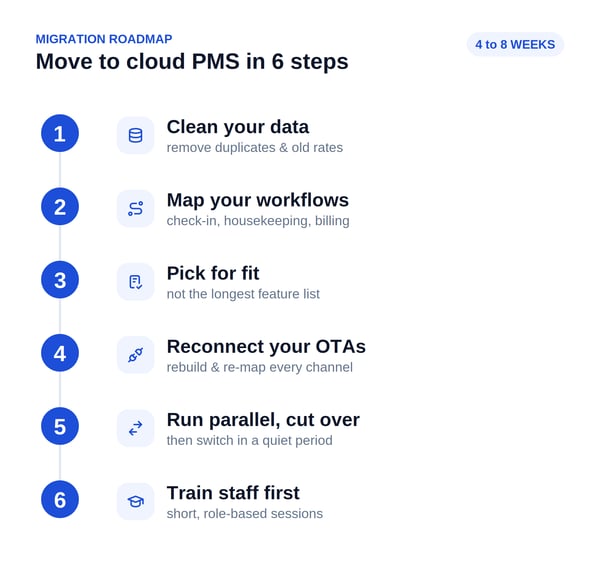
1. Clean your data first. Spend a week or two tidying records before you export anything. Duplicate guest profiles and old rate plans are the top reason migrations run long.
2. Map your daily workflows. Write down how you run check-in, housekeeping handover, billing, and night audit today. This becomes your setup checklist so nothing quietly disappears.
3. Pick a system that fits, not the longest feature list. Match the software to how your team actually works. A simple, guided interface your least tech-savvy staff can use beats a feature-heavy system nobody adopts.
4. Reconnect your OTAs and re-map your rooms. Channel links do not carry over. Each new PMS rebuilds them through its own channel manager setup, so every OTA connection needs to be re-tested before go-live. Softinn's channel manager connects to 100+ OTAs, including the ones that matter here like Agoda and Traveloka. Room mapping matters just as much: your room types in the PMS must line up exactly with how they appear on each OTA. This step is more common than it sounds: 49.76% of Softinn hotels run their PMS connected straight to a channel manager, so a clean re-map is worth getting right the first time.
5. Run both systems in parallel, then cut over in a quiet period. Keep the old and new systems running side by side for 24 to 48 hours, then make the final switch on a low-occupancy midweek or shoulder-season day. Old historical folios often do not import cleanly, so most hotels keep them as a read-only export.
6. Train your team before go-live, not after. Short, role-specific sessions beat one long class. A modern interface cuts training time sharply, turning weeks into days.
Get your front desk confident on the new system fast. Our kit gives you ready-to-use training material so your team is ready on day one.
What changes in daily operations after you switch?
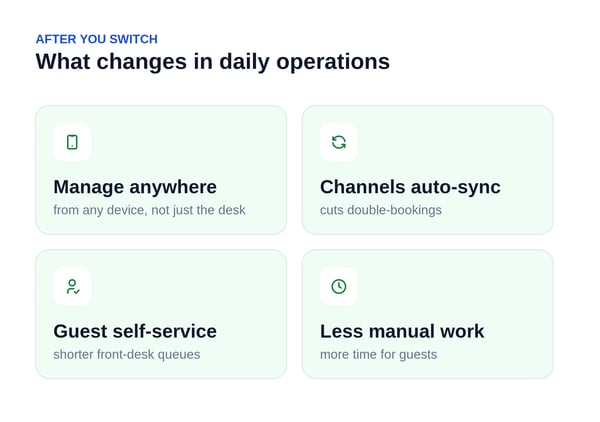
- Manage from anywhere.
- Check occupancy, adjust rates, or approve a booking from your phone. That fits Southeast Asia, where booking and management are increasingly mobile-first.
- Channels stay in sync.
- When a room sells, availability updates across your OTAs automatically, which is how modern systems cut overbooking.
- Guests can self-serve.
- A cloud PMS integrates with self-service tools. Softinn's Kiosk, for example, reduces front desk queues by up to 65.7%, based on our own product reporting.
- Less manual work.
- Real-time syncing and reporting remove the repetitive tasks that eat up a small team's day.
One point worth being precise about: your Channel Manager, Booking Engine, and Kiosk are separate Softinn products that integrate with the PMS, not features bundled inside it. That lets you add each piece as you grow.
What should a small hotel in Southeast Asia look for?
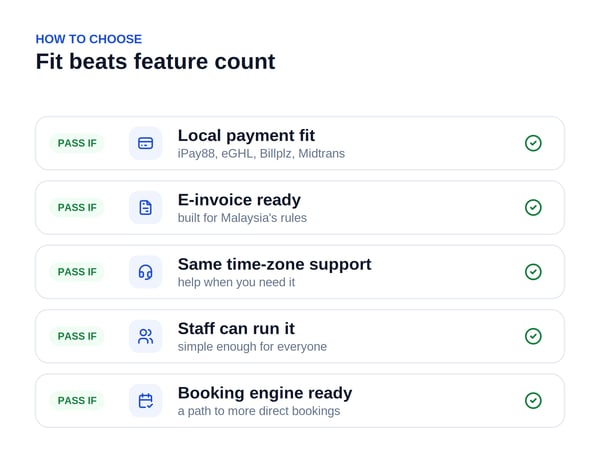
- Local payment and OTA fit. For a SEA property, that means local payment gateways such as iPay88, eGHL, Billplz, and Midtrans, plus strong connections to Agoda, Booking.com, and Traveloka. Softinn supports all of these.
- Local compliance. Malaysia's move to mandatory e-invoicing makes local-market fit non-negotiable. Choose a system built for the rules you actually operate under.
- Reliability and support in your time zone. When something breaks, you cannot wait a day for a reply from another region.
- Ease of use. If your least experienced staff cannot run it, it is the wrong system.
- Room to grow direct bookings. OTAs bring discovery. Your own channels keep the margin. We frame that shift as a simple path: traffic, offer, convert. OTAs give you the traffic; a booking engine on your own site turns that discovery into commission-free stays. A PMS that integrates cleanly with a booking engine is what makes the path workable for a small team.
I believe the winning system is the one your team uses fully, connects cleanly to your OTAs, and supports the payment methods your guests already trust.
FAQ
-
How long does it take to move a small hotel to a cloud PMS?
-
About four to eight weeks for a single property. Most of that is planning, data cleanup, and training. The cutover itself is short.
-
-
Will I lose my bookings and guest data?
-
No, if you sequence it right. Future reservations and active guest profiles migrate before the switch. Very old folios are usually archived as a read-only export.
-
-
How much does it cost?
-
Around RM 9 to RM 41 (USD 2 to 10) per room per month, or roughly RM 410 to RM 1,230 (USD 100 to 300) monthly for a 20-room hotel, depending on modules. Compare the total twelve-month cost.
-
-
Do I need to be technical to run one?
-
No. A good cloud PMS is built for non-technical staff, which is why training now takes days rather than weeks.
-
-
Does it work for vacation rentals?
-
Yes. Cloud systems suit boutique hotels, budget hotels, resorts, and vacation rental operators alike.
-


Tai Pei Shi
Hi, I am Pei Shi. I am a Technopreneurship student and digital marketing intern in Softinn.
Comments
Recent Posts
Hotel Wi-Fi PMS Integration: Give Every Guest Their Own Password, Automatically
AI Won't Run Your Hotel. But It Can Help You Run It Better.
Google AI Mode for Hotels: What Hotel Owners Need to Know
When the Minimum Wage Goes Up, What's Your Hotel's Next Move?
Why Hotels Should Offer Reserve Now, Pay Later to Guests