
The Malaysian Governement is discussing raising the national minimum wage from the current RM1,700 to somewhere between RM2,500 and RM3,100.
More recently, there are signals that the increase may apply to larger companies, leaving SMEs exempt. If you run an independent hotel, you might read that as good news.
We'd encourage you to look a little further ahead.
The Number that Matters Isn't Just on Your Payroll
Even if your hotel is classified as an SME and the wage legislation doesn't apply directly to you, the labour market around you is about to shift. When larger employers begin offering higher wages, talented and reliable workers, like your front desk officers, your experienced housekeeping supervisors, your steadiest operations staff, now have more reason than ever to move on to bigger companies.
Who then wants to work for an SME?
This is one of the less obvious consequences of rising wage expectations that hotel operators should be thinking about.. It's not just the direct cost of wages. It's the rising cost of turnover, the harder recruitment pipeline, and the operational gaps that appear when good people leave for employers who can simply afford to pay more. For a hotel, where service quality is inseparable from the people delivering it, that's a serious structural problem, even if your wage bill stays flat.
Do The Math For Your Own Business
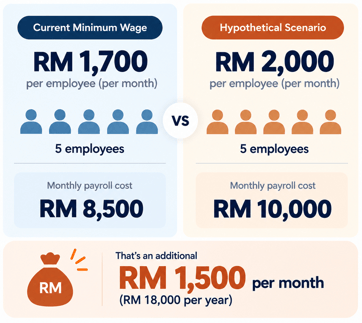
If the increase does eventually extend to SMEs, the impact could be significant.
For example, consider a small hotel with just five employees earning RM1,700 per month. If the minimum wage were to increase to RM2,000, here's how much the hotel's payroll costs would change.
That's an additional RM18,000 per year in basic wages alone, excluding employer contributions and other employment costs.
Either way, the pressure is coming. The form it takes, whether a direct wage cost or an indirect talent retention problem, is almost secondary to the question of how you're preparing for it.
Four Moves Worth Thinking About Now
-
Shift structure and scheduling.
Before looking at headcount or technology, look at your shift patterns. Many hotels are overstaffed at predictable low-traffic hours and understaffed when it counts. A scheduling audit often reveals recoverable capacity, without cutting anyone.
-
Cross-train your team.
A front desk officer who can assist with housekeeping coordination during a busy turnaround is worth more than two siloed specialists. Cross-training builds operational resilience and makes individual roles more engaging, both of which matter when you're competing to retain good people.
-
Review your pricing strategy.
Rising labour costs, direct or indirect, are a legitimate business input. Modest, well-timed rate adjustments on peak dates and direct booking channels can offset a meaningful portion of the pressure, if approached thoughtfully before you're under strain.
-
Consider where technology genuinely helps.
This one deserves nuance, so let's be direct: technology doesn't replace your team. What it does is change what your team spends their time on.
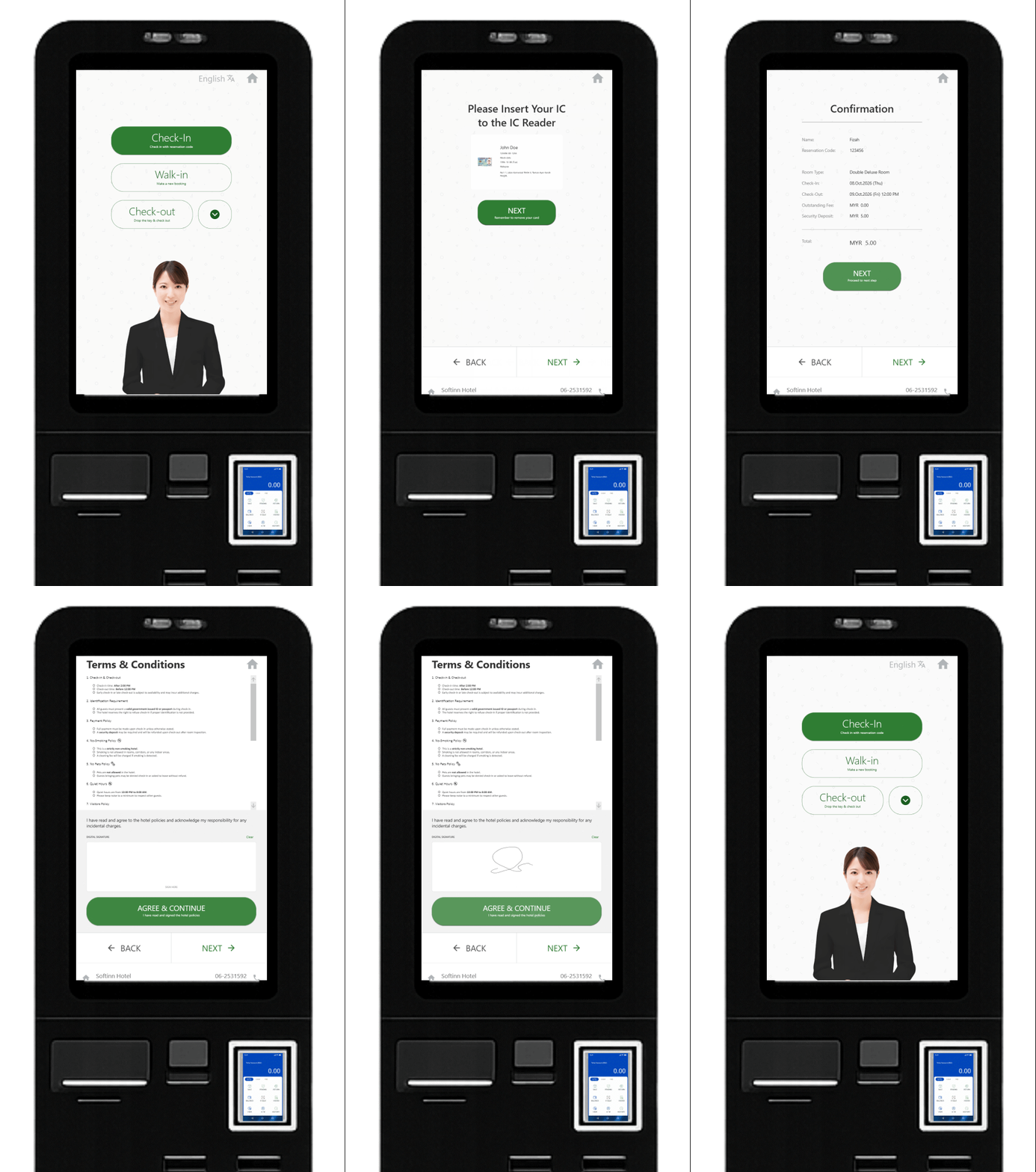
A self check-in kiosk handles the transactional part of arrival, such as ID verification, room assignment, key issuance, payment, so that when you're running lean, your staff aren't stuck processing paperwork while a queue builds at the counter. They're free to focus on the moments guests actually remember: the warm welcome, the local tip, the problem that needs a real person to solve it. A guest who moves through check-in smoothly and then gets genuine, unhurried attention from your team is a guest who comes back. That's what the technology is meant to protect, not the headcount number, but the quality of the interaction.
Want to see how a self check-in kiosk works in practice for a property like yours? We run regular product tours for hotel operators.
Reserve your spot →
What Not To Do
Don't panic-cut. Turnover is expensive, i.e. the replacement costs, retraining time, and the dip in service quality that always shows up in your reviews before it shows up in your accounts.
And don't wait. Whether the final figure is RM 2,000 or RM 3,100, and whether it applies to SMEs or not, the direction of travel is clear. Hotels that adapt their operations thoughtfully over the next 6 to 12 months will be in a far better position than those who scramble once the policy is finalised.
The Bigger Picture
Labour cost pressure isn't unique to Malaysia, and it isn't going away. The hotels that manage it well won't necessarily be the ones with the most technology or the lowest headcount. They'll be the ones who understand where human attention creates the most value, and build their operation around protecting that.
That's worth thinking about now, regardless of what the final wage figure turns out to be.
Disclaimer: The views in this article are the author's own and are intended for informational purposes only. Every hotel operates differently, and decisions about staffing and technology should be based on your specific operational needs, team structure, and guest expectations. Softinn does not advocate for any single approach to staffing or automation.


Caren
Caren is a Co-Founder of Softinn and a qualified accountant (ACCA). She didn't set out to be a blogger. She just noticed things that needed to be said. After years of building a team, hiring, and developing & testing software for independent hotels across Malaysia and Southeast Asia, she writes here to share what she wishes someone had told her - about people, and about the tech ecosystems they work with.
Comments
Recent Posts
When the Minimum Wage Goes Up, What's Your Hotel's Next Move?
Why Hotels Should Offer Reserve Now, Pay Later to Guests
API, AI, Integration: Should Your Hotel Build or Buy?
The Best AI Preparation Your Hotel Can Do Has Nothing to Do With AI
The e-Invoice Exemption Increased to RM3Million : What It Means For Your Hotel?