
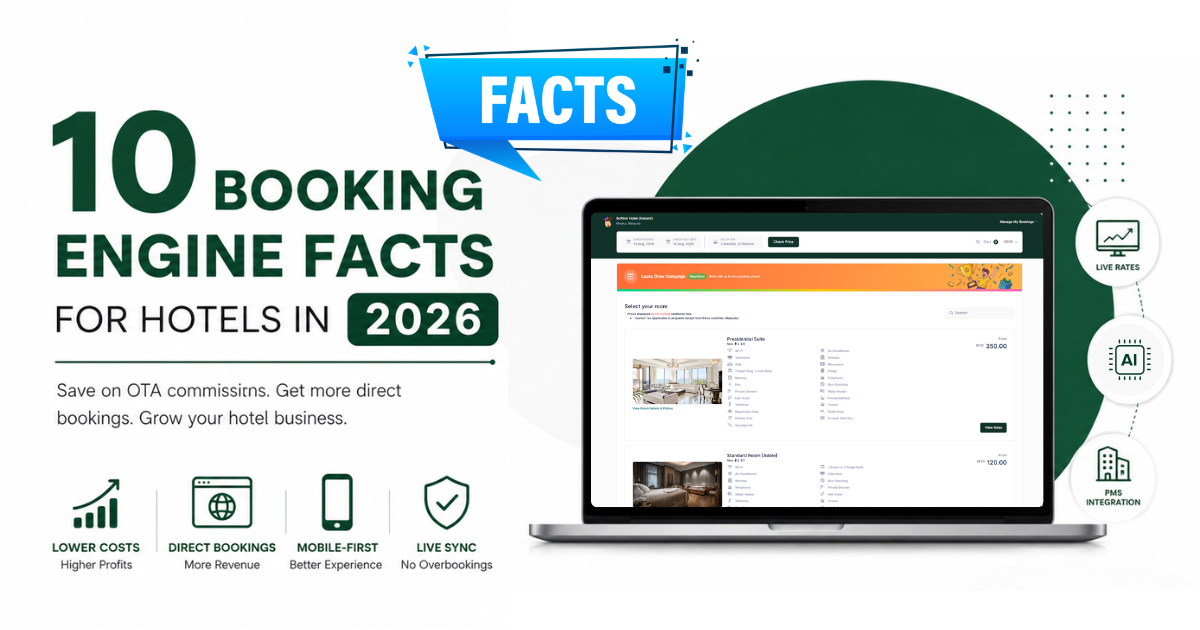
Quick answer: A hotel booking engine is the tool on your own website that lets guests book and pay you directly, with no OTA commission. In 2026 it is the cheapest way to win a booking, and it is fast becoming the difference between a website that earns and one that just looks nice. Here are ten facts every small hotel owner should know before choosing, fixing, or trusting one. Together, they trace the Direct Booking Path we use with every hotel we onboard: win the traffic, make an offer worth booking, then convert it on your own site.
Fact 1: OTAs still bring most of your bookings, and they keep getting pricier
Online travel agencies took 63.4% of independent hotel bookings, rising to nearly 80% in some markets in 2025. Commissions now sit at 15% to 25%, and the true cost climbs past that once you pay for preferred placement or promotions. In Malaysia and the wider region, Agoda is the number one OTA and charges 18% to 25%, so the pinch is even sharper here.
A booking engine will not replace OTAs. What it does is let you win back margin on the guests you already own: repeat stayers, brand searchers, and travellers who would have booked you anyway.
Fact 2: A direct booking costs a fraction of an OTA booking
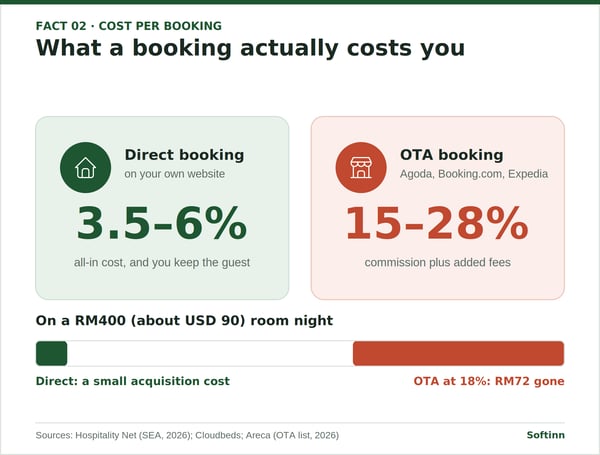
This is the number that matters. For Southeast Asian hotels in 2026, a direct booking costs roughly 3.5% to 6% all-in once you count paid media, your website, the booking engine, and the team. That is a fraction of the 15% to 28% OTA tax, and the guest relationship stays with you.
On a RM400 (about USD 90) room night, an 18% commission is RM72 (about USD 16) gone. The same booking through your own engine costs you far less. Shift a handful of bookings direct each week and the saving is real money by year end.
Fact 3: A booking engine is only as good as its sync
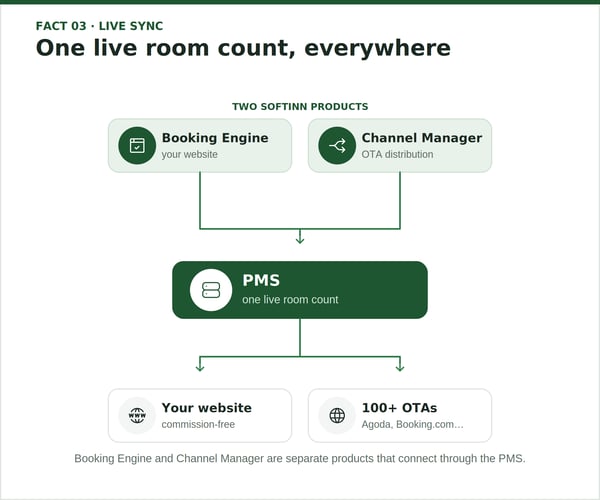
A booking engine on its own is not enough. It has to talk, in real time, to your channel manager and your property management system. Without that live two-way sync, you get overbookings and rate disparity, the two fastest ways to lose money and trust.
At Softinn, the Booking Engine and Channel Manager are separate products that connect through the PMS in the middle. That is what keeps one live room count across every OTA and your own website. Here is how the booking engine and channel manager work together.
Fact 4: Google now shows your direct rate for free

Google runs over 90% of global search, and its Free Booking Links let your direct rate appear next to OTA rates at no cost and no commission, labelled as your official site. To show up, you need a booking engine and channel manager pushing your live rates to Google.
Softinn was the first company in Malaysia that Google approached to connect hotels through the Google Hotel Booking Link, so this feeds straight from how the booking engine already works.
Read more: How to Cut OTA Commissions With a Hotel Booking Engine
Fact 5: AI search is becoming a booking channel, and it reads the same feed

This is the newest shift, AI answer engines and Google's AI results now increasingly pull from the same live rate feed that powers Free Booking Links. If your rates are not feeding Google, an AI assistant answering "where can I book this hotel" will surface only the OTAs, not you.
That is why AEO, or Answer Engine Optimisation, now matters as much as SEO. SEO ranks you on a page. AEO gets you named inside the AI's answer when a traveller asks "where should I stay in Langkawi". To win it: feed your live rates to Google through your booking engine, write your pages the way guests ask questions, and point every visitor at a one-tap booking link.
This is where the Softinn Website Content Management System earns its keep: its marketing tools let you publish blog posts and answer real guest questions yourself, no developer needed, building exactly the content AI engines lift. Do that and the AI puts your hotel in front of a ready traveller and sends them straight to your own booking page, the job an OTA used to charge you for. A connected booking engine is now part of being visible in AI search, not just Google search.
Fact 6: Most direct bookings are abandoned before payment
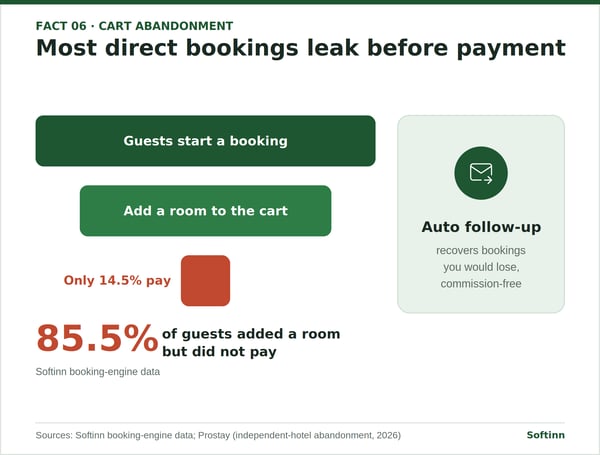
Our own booking engine data tells a blunt story: 85.5% of guests did not pay after adding a room to the cart. It matches the wider picture, travel has one of the highest cart abandonment rates online.
That is not lost revenue. It is revenue waiting for a nudge. A booking engine that automatically follows up with those guests recovers bookings you would otherwise hand to an OTA, commission-free, by tracking user actions and triggering automated emails or text messages when someone fills in their contact details but leaves the page before paying.
Fact 7: Most guests book on mobile, so speed decides the sale

Around 65% of hotel bookings now happen on mobile, and mobile carts are abandoned far more often than desktop. A slow or clunky mobile checkout is the single easiest way to push a ready guest back to the OTA app they already have.
For a hotel website in Malaysia, you have about 90 seconds to convince a traveller to book direct instead of on Booking.com or Agoda. A booking widget placed above the fold, pre-filled with today's date, can lift booking-engine click-through by around 30%. Your booking engine should be mobile-first, load fast, ask for few details, and offer the local payment methods your guests actually use.
Softinn's Booking Engine supports payment gateways in Malaysia and Indonesia for exactly this reason.
📥 Free download: Hotel Booking Engine Selection Checklist →
A simple, practical checklist to help you choose or fix a booking engine, covering sync, mobile speed, payment, and the features that actually move direct bookings. Written for small independent hotels.
Fact 8: Rate parity rules have loosened
In the EU, the rules changed sharply: under the Digital Markets Act, Booking.com dropped its rate parity clauses for European inventory on 2 December 2024, so hotels there can now openly price direct below the OTA. In Malaysia and most of Southeast Asia there is no equivalent rule, and OTA contracts still shape what you can publish. So do not build your strategy on undercutting the OTA on price. Build it on value the OTA cannot copy.
You do not always have to be cheaper. You have to be better value. A small direct-only perk that an OTA cannot match, like a free breakfast, late checkout, or welcome drink, often wins the booking on its own.
Fact 9: Direct guests are worth more than OTA guests
The most valuable thing a direct booking gives you is not a bigger basket, it is the guest. Book someone on your own site and you get their email, their preferences and permission to bring them back, none of which an OTA will hand over. That is the difference between renting a guest once and owning a relationship you can sell to again at near-zero cost.
Direct bookings also tend to be worth more and cancel less. Independent research from Kalibri Labs, across roughly 18,000 US hotels, found direct bookings about 12.5% more profitable than OTA bookings even after marketing spend, and direct bookings cancel at markedly lower rates than OTA bookings.
Just as important, a direct booking gives you the guest's email and details. That is the fuel for repeat stays, and you never get it from an OTA.
Fact 10: You do not need to drop OTAs, you need the right mix
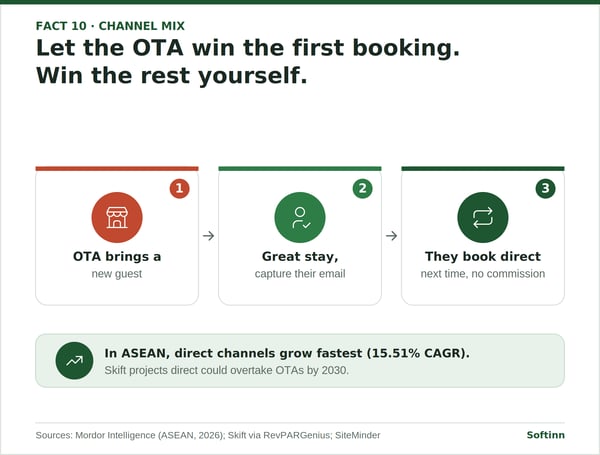
Softinn's own customers show the mix works: 56.94% take direct bookings through the Softinn Booking Engine, and 43.52% now run with little to no OTA reliance. Their website is a real booking channel, not a brochure.
The smart play is not zero OTA. It is letting the OTA win the first booking, then winning every booking after that yourself. The global direct booking average is around 28%, and a healthy target for an independent hotel is roughly 30% to 40%.
The regional trend is on your side. In the ASEAN online accommodation market, worth USD 30.17 billion in 2026, direct and captive channels are the fastest-growing segment at a 15.51% CAGR, and Skift projects direct could overtake OTAs as the dominant channel by 2030.
The hotels that win are the ones turning OTA-discovered guests into direct repeat bookings.
Where I stand
I believe the goal was never to beat the OTAs at their own game. It is to own the guest relationship. A booking engine is how a small hotel turns one-time OTA guests into direct, repeat guests it actually knows. Win the traffic, make an offer worth booking, convert it on your own site: that is the Direct Booking Path, and it is how a hotel becomes what every owner wants it to be, predictable and profitable.
Here is a practical playbook to attract, convert, and keep more direct guests without slashing your rates. Written for independent hoteliers, no fluff, for growing commission-free bookings.
Read also


Tai Pei Shi
Hi, I am Pei Shi. I am a Technopreneurship student and digital marketing intern in Softinn.
Comments
Recent Posts
When the Minimum Wage Goes Up, What's Your Hotel's Next Move?
Why Hotels Should Offer Reserve Now, Pay Later to Guests
API, AI, Integration: Should Your Hotel Build or Buy?
The Best AI Preparation Your Hotel Can Do Has Nothing to Do With AI
The e-Invoice Exemption Increased to RM3Million : What It Means For Your Hotel?