
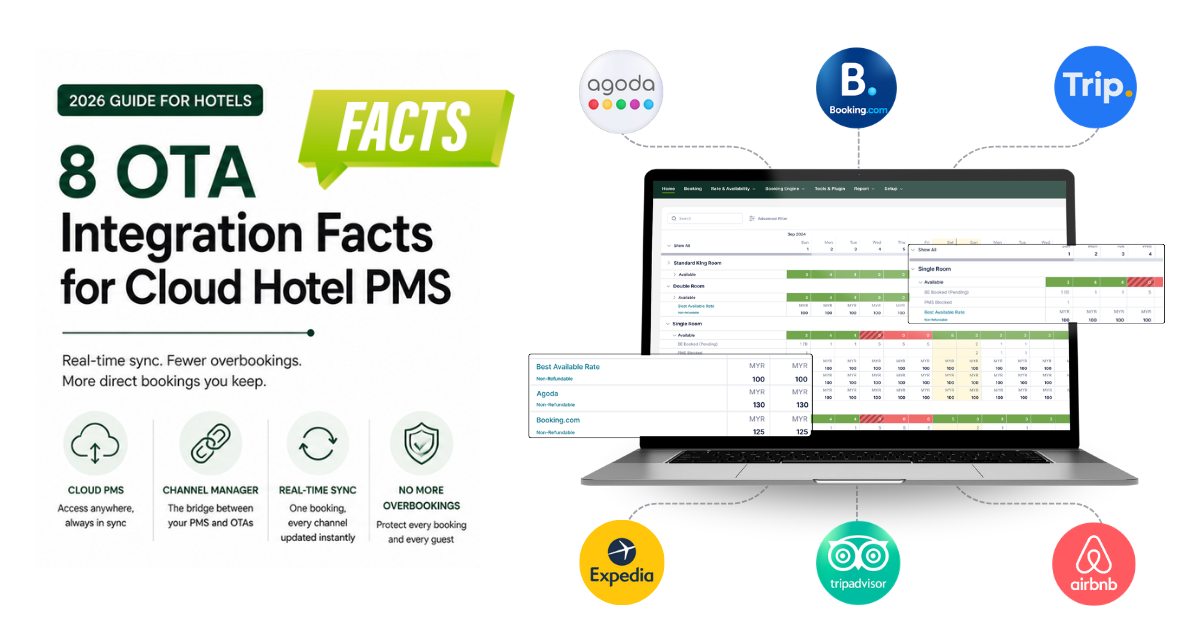
OTA integration in a cloud hotel PMS keeps your room availability, rates, and booking rules in sync across every online travel agency you sell on, automatically. In most setups your property management system does not talk to Booking.com or Agoda directly. A channel manager sits in the middle and does the syncing. Get this connection right and you stop double bookings before they happen.
If you are shopping for hotel property management systems right now, OTA integration is one of the first things to test. Below are eight facts that show you the difference between software that just looks connected and software that actually keeps your inventory clean. Get it right and the payoff is not just a tidy calendar; it is a hotel that runs predictably: no walked guests, no manual extranet edits, no surprises at the counter.
Fact 1: OTA integration runs through a channel manager, not your PMS directly
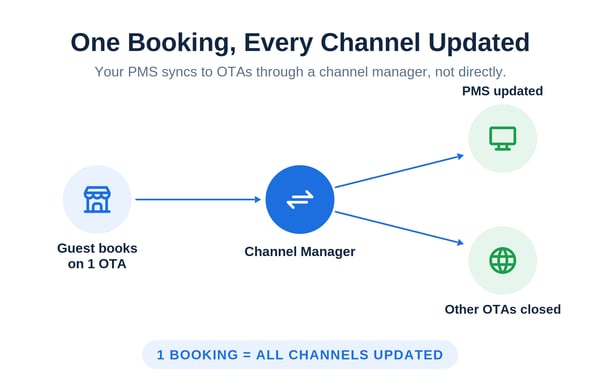
Your PMS is the brain of daily operations. It handles reservations, check-in, housekeeping status, and billing. It is usually not the tool that pushes your rates out to OTAs. A channel manager does that.
Here is the flow. A guest books on Agoda. The channel manager receives it, updates your PMS, and closes that room on Booking.com, Expedia, and your other channels at the same time. One booking, every channel updated.
This is why the framing matters: a good cloud PMS integrates with a channel manager. They are separate tools doing separate jobs. At Softinn, close to half (49.76%) of hotels across our customer base connect their PMS directly to a channel manager for exactly this reason.
Read more: How Does a Channel Manager Work?
Fact 2: Two-way sync is what actually prevents overbooking
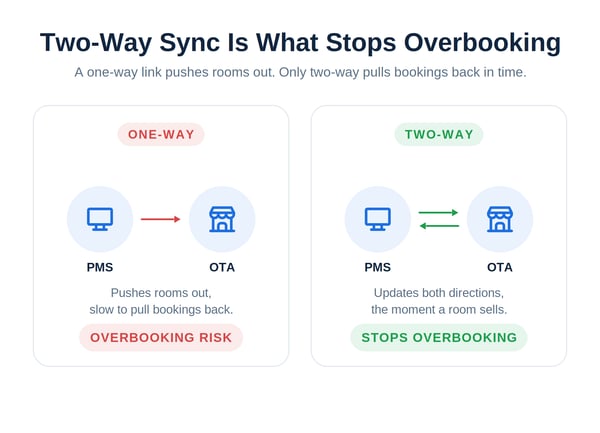
Not every connection is equal. A one-way connection pushes your inventory out to OTAs but is slow to pull new bookings back. A two-way connection does both, in near real time. Only two-way sync closes the loop tight enough to stop overbooking.
This is also where a proper channel manager beats a simple iCal link. iCal can share a calendar, but it updates on a delay, which is a real overbooking risk on busy dates.
When you test hotel software, ask one plain question: is this a two-way connection with my OTAs?
Read more: Overbooking: How To Solve, Pros and Cons.
Fact 3: "Real-time" still has a speed gap, so ask how fast
Almost every vendor says "real-time." The honest answer is that every sync has a small window between a booking coming in and every other channel updating. Double bookings sneak into that window.
A cloud channel manager keeps that window as short as possible. During peak season, the difference between a two-second update and a two-minute update is the difference between a clean night and an angry guest at the counter.
Ask the vendor how quickly a booking on one OTA closes the room everywhere else.
Fact 4: OTA integration syncs three things, not one
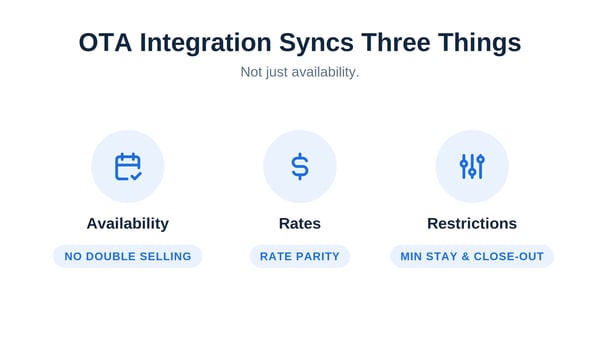
Availability is the obvious one. But solid online travel agency connectivity syncs three things together:
- Availability, so you never sell a room twice.
- Rates, so your prices stay consistent and you protect rate parity.
- Restrictions, such as minimum stay and closed-to-arrival rules.
If your software only syncs availability, you will still be logging into each OTA extranet to fix prices and rules by hand. That is the manual work you were trying to remove.
Fact 5: Room mapping decides whether the integration works
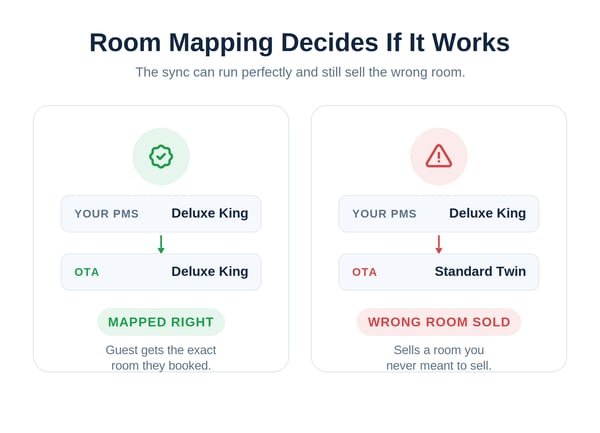
This is the step most hoteliers underestimate. Room mapping links each room type and rate plan in your PMS to the matching room type on every OTA. If a Deluxe King in your system is mapped to a Standard Twin on Booking.com, the sync will run perfectly and still sell the wrong room.
Clean mapping is quiet and boring, which is exactly why it gets skipped. Do it carefully once and the whole integration behaves.
Free resource: PMS and OTA Room Mapping Excel Template🡢
Map your room types and rate plans across every OTA before you go live, so nothing gets sold as the wrong room.
Fact 6: The OTA list matters more than the OTA count
A wall of 300 OTA logos looks impressive. What actually matters is whether the specific channels your guests use are on the list.
For Southeast Asia, that means regional players, not just the global giants. Regional favourite Agoda climbed in 40% of SiteMinder's Top 12 channel lists in 2025 and took the top spot in the Philippines and Taiwan, while India's MakeMyTrip and Goibibo re-entered the Malaysia list. If your channel manager cannot connect to the OTAs your market lives on, the count is meaningless.
Softinn Channel Manager connects to 100+ OTAs. You can check the full, current list here: Softinn Channel Manager Integrated OTAs List.
When you evaluate property management software, do not count the logos. Check that your must-have OTAs are on the supported list.
Fact 7: OTA dependence is real, but integration should still feed your direct bookings
OTAs are not the enemy. They bring visibility you cannot easily buy on your own. Online travel agencies captured 63.4% of all bookings for independent properties in 2025, up from the year before, and reaching close to 80% in some markets. That reach comes at a price: OTA commissions typically run from 15% to 30% per booking.
The smart move is to use OTAs to get discovered, then convert your next guests to direct. The pathway is growing: 18% of travellers who start their search on an OTA end up booking directly, up 3.3 points year on year, and direct bookings averaged US$516 in 2025 versus US$312 for OTA bookings. Direct guests are worth more and cost less.
Good OTA integration should make that shift easier, not lock you into paying commission forever. At Softinn, more than four in ten hotels across our customer base (43.52%) operate without heavy OTA reliance because the goal is a healthy channel mix, not OTA dependence.
Free resource: The Direct Booking Path E-book from Softinn 2026→
A simple framework, traffic to offer to convert, for turning OTA visibility into direct bookings you keep.
Fact 8: The integration is only as reliable as your cloud PMS
Every fact above depends on one thing: your PMS being online and in sync. A cloud PMS is accessible from anywhere, keeps syncing even when nobody is at the front desk, and does not go dark when your office computer restarts.
Two questions worth asking any vendor before you sign:
- What is your uptime, and how is sync handled if a connection drops?
- When the integration breaks, who owns the fix, you, the PMS vendor, or the channel manager?
That last question is the most under-asked in the whole process. If the PMS points at the channel manager and the channel manager points at the PMS, you are the one walking the guest at midnight. This is one reason I believe in keeping the PMS and channel manager under one roof. At Softinn both are our own products, so when something goes wrong there is one team to call and no finger-pointing between vendors. You are not the one left translating between two suppliers at midnight.
Where I stand
I believe OTA integration should be judged by two questions. Does it quietly prevent overbooking without you thinking about it? And does it free you to grow direct bookings instead of trapping you in commission?
This is also why I do not think of the PMS, channel manager, and booking engine as one product with a long feature list. They are separate tools that connect cleanly, and each does one job well. Fit over features. The right question is not "how many OTAs," it is "does this fit how my hotel actually sells rooms."
Frequently asked questions
-
Does a cloud PMS connect to OTAs directly?
-
Usually not. The PMS connects to a channel manager, and the channel manager connects to the OTAs. The PMS manages your operations while the channel manager handles distribution.
-
-
Is a channel manager the same as a PMS?
-
No. A PMS runs daily hotel operations. A channel manager distributes your rooms to OTAs and syncs inventory. They work best when integrated, but they are separate tools with separate jobs.
-
-
How many OTAs should my channel manager connect to?
-
Enough to cover the channels your guests actually use. For Southeast Asia that usually means the global players plus strong regional OTAs. Match the list to your market rather than chasing the highest number.
-
-
Does OTA integration stop overbooking completely?
-
Two-way, near real-time sync removes almost all of the risk by closing rooms across every channel the moment one sells. A small update window always exists, so faster sync and clean room mapping matter.
-


Tai Pei Shi
Hi, I am Pei Shi. I am a Technopreneurship student and digital marketing intern in Softinn.
Comments
Recent Posts
The e-Invoice Exemption Increased to RM3Million : What It Means For Your Hotel?
7 Cloud PMS Safety Facts for Small Hotels
Hotel Booking Engine Integration for Lower OTA Costs
8 Hotel Booking Engine Mistakes That Cost You Direct Bookings
Hotel PMS Payments and Chargeback Protection Guide