
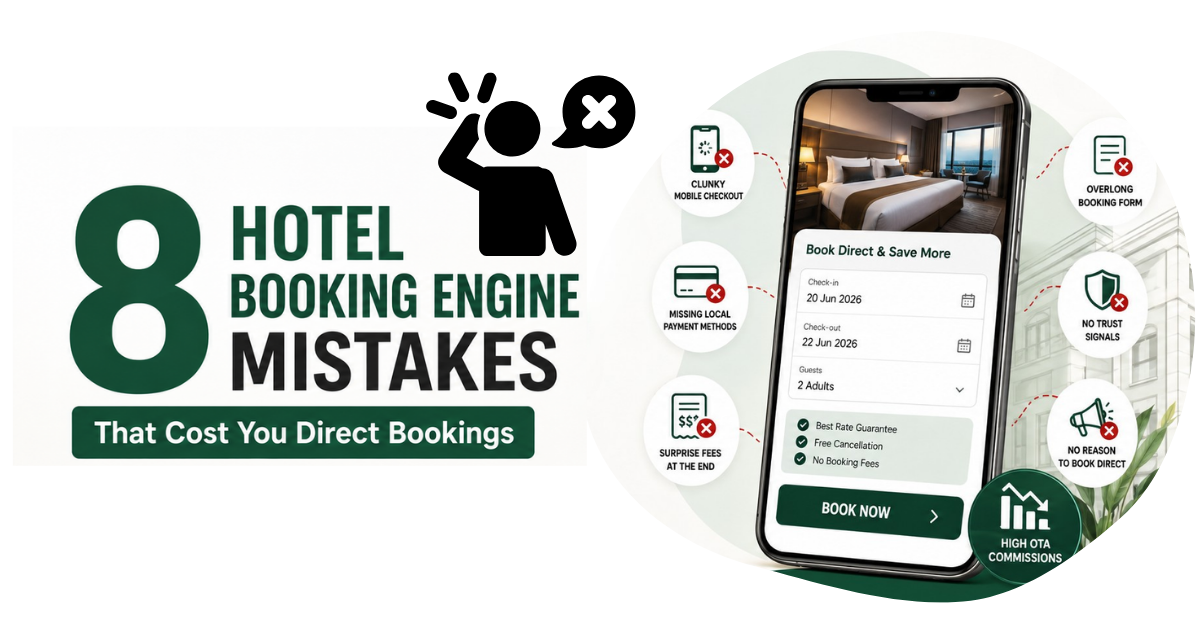
Quick answer: Most small hotels lose direct bookings not because their rates are wrong, but because their booking engine quietly leaks guests before payment. The eight most common mistakes are a clunky mobile checkout, missing local payment methods, surprise fees at the final step, an overlong booking form, no trust signals near the Book button, no reason to book direct, skipping Google Free Booking Links, and no follow-up on abandoned bookings.
Fix these and you move bookings from a channel that costs 18 to 30% down to one that costs around 2 to 5%. A guest found your hotel, liked what they saw, and they want to book on your own site but can't complete the whole process. That is the most expensive kind of lost booking, because you already earned it. Across Southeast Asia, OTA channels routinely capture 18 to 30% of room revenue in commission.
The good news: a booking engine is a fixable machine, not a mystery. Here are the eight mistakes we see most often at independent hotels in the region, and what to do about each one.
These eight failures aren't random. Each one belongs to a stage of the Direct Booking Path: Traffic (how guests find you), Offer (why they book direct), and Convert (what makes finishing easy). We've tagged each mistake with its stage, so you can see which part of your path is leaking.
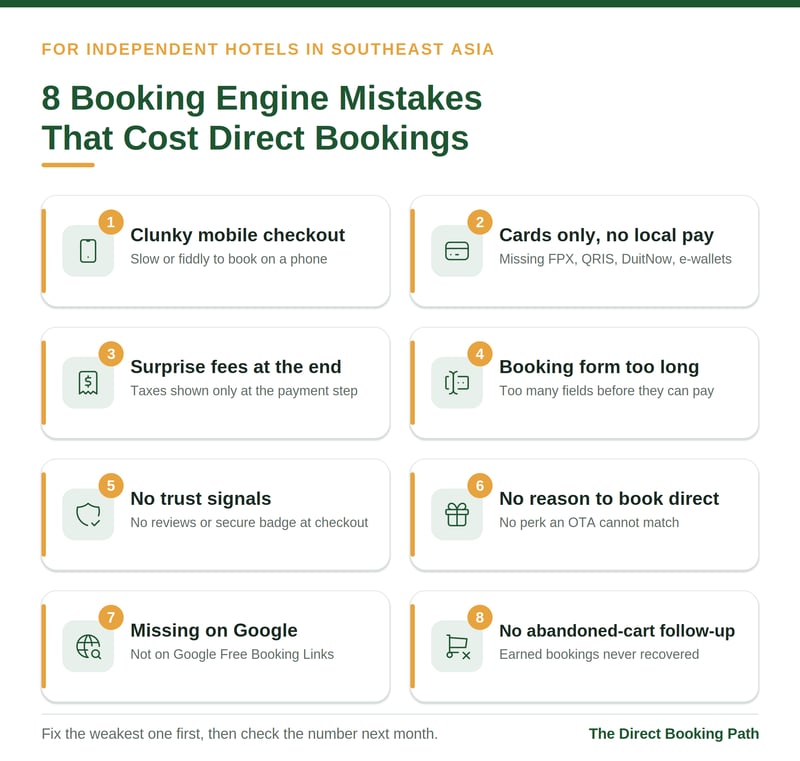
1. Booking engine painful on a phone
Mobile is the default now. Over half of OTA bookings already happen on smartphones, and independent hotel sites convert at only 1.5% to 2.5% on desktop, lower on mobile. Speed is part of the problem too: every extra second of load time can cut conversion by 7% to 10%.
The fix is not a redesign. Take out your own phone tonight, open your website the way a guest would, and book a room. Time it. Every moment you hesitate, squint, or scroll hunting for a button is a moment a real guest gives up.
2. Only accept international cards
This one silently kills conversions. Southeast Asia is not a card-first market. Malaysia runs on FPX and DuitNow QR, Indonesia on QRIS and wallets like GoPay and DANA, Thailand on PromptPay, and the Philippines on GCash. A guest who reaches your payment page and finds only a Visa or Mastercard form does not see an inconvenience. They see a dead end.
Enable the local rails your guests already trust, alongside cards for international travellers. A familiar payment screen is a trust signal doing double duty.
3. Guests can't see the real total at the final step
If tax and service charge appear for the first time on the payment screen, the guest feels baited. That is the exact moment they return to the OTA, "where the price was the price." In Malaysia that means showing SST at 8% on accommodation and any tourism tax up front, not as a nasty surprise at checkout.
Show the true, all-in total early in the flow. Transparent pricing feels like confidence. Hidden pricing feels like a trap.
4. Booking form ask for too much
Every field on your booking form is a toll gate. Ask of each one: do we truly need this to confirm the booking? Name, contact, dates, payment, yes. Passport number, full home address, "how did you hear about us," no. Baymard's checkout research points to a too-long or complicated checkout and forced account creation as top reasons guests abandon before paying.
Collect the nice-to-know details at check-in, when the booking is already secure. The form has one job: to finish.
5. Don't have Trust signals where the guest decides
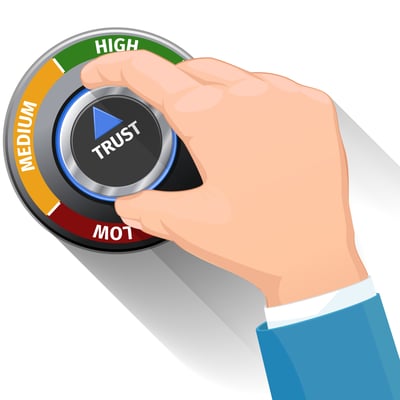
A guest booking on Agoda borrows Agoda's credibility. A guest on your own site has only what your page shows them. Three signals close that gap: guest reviews near the booking button, secure-payment badges at the payment step, and cancellation terms in plain language shown before payment.
"Free cancellation until 3 days before arrival" beats a paragraph of clause 7(b). These are small additions, but they land at the precise second a guest decides whether to trust you with their card.
Free resource: Want the full playbook behind these fixes? Download The Direct Booking Path e-book. It breaks direct booking into three stages you can measure and fix one at a time (Traffic, Offer, Convert), with a self-scoring scorecard for your own property. Get the free e-book →
6. No real reason to book direct instead of on the OTA

Most OTA agreements include rate parity, so you often cannot be cheaper on your own site. Many owners hear that and give up. That is a mistake, because 18% of travellers who start on an OTA now book directly, up 3.3 points year on year. They are actively looking for a reason to choose you.
Give them one your booking engine can display: a direct-only perk. Late checkout when occupancy allows, a welcome drink, or a free upgrade when available. The OTA can match your rate. It cannot match your hospitality. The direct offer does not need to be cheaper; it needs to be worth more.
7. Not invisible on Google Free Booking Links
When a guest Googles your exact hotel name, what appears first: your own bookable rate, or the OTA listing? For many independent hotels in the region, it is the OTA, which means you pay commission on a guest who was already looking for you.
Google Free Booking Links put your direct rate right next to the OTAs inside Google Search, Maps, and Travel, at zero commission. This is the single biggest free lever most small hotels skip. If your booking engine integrates with Google, switch it on.
Read also: Direct Hotel Booking Strategy for Small Hotels
8. Just let abandoned bookings go
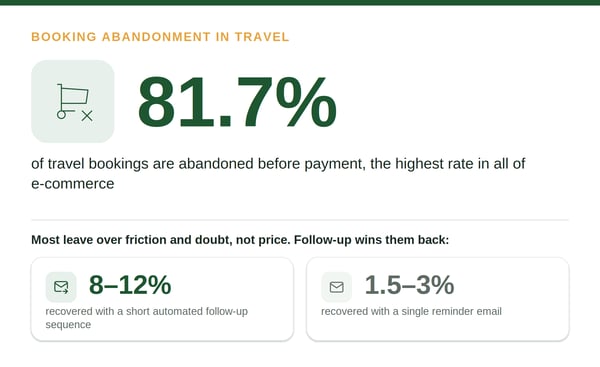
Travel has the highest cart abandonment in all of e-commerce, at 81.7%. Most of those guests leave because of friction and doubt, not price. Without a nudge, they never come back.
A booking engine that automatically follows up on abandoned bookings recovers revenue you already paid to attract. A short email sequence recovers 8% to 12% of abandoners, against 1.5% to 3% for a single reminder. No discount needed, just a reminder that the room is still waiting.
Where I stand
I believe most hotels do not have a rates problem. They have a booking-path problem. The guest was ready to book. The engine got in the way somewhere between the room photo and the payment button.
And direct guests are worth more than the rate suggests: SiteMinder's 2026 research found OTA bookings cancel at 21.8%, more than double the 10.6% rate for direct bookings. Direct guests turn up. For an independent hotel, a direct share of 30% to 40% is a realistic target, not a fantasy.
Cutting OTA commission is not about being cheaper than Agoda, and it is not a marketing vanity project. It is the difference between a hotel that survives on thin margins and one that runs a predictable, profitable business. OTAs are a channel, not a landlord. Your booking engine is where you win the guests you already earned, so it deserves the same attention you give your rooms.
None of these eight fixes needs a developer or a big budget. Pick the weakest one, fix it this week, and check the number again next month.
Free resource: Ready to walk the full path? The Direct Booking Path e-book gives you the framework and a ten-minute scorecard to find your own hotel's weakest stage. Download it free →
Frequently asked questions
-
What is the most common hotel booking engine mistake?
-
A checkout that is painful on mobile. With most travel research and booking in Southeast Asia happening on a phone, a flow that is tolerable on desktop but clunky on mobile leaks bookings you already earned.
-
-
How much commission do OTAs really charge in Southeast Asia?
-
The headline rate is typically around 15%, but once visibility programmes, payment processing, and promotional participation stack up, the total cost can reach 28% of the booking. A direct booking through your own engine has no commission; the main cost is the payment gateway, typically 2% to 5%.
-
-
Does Google Free Booking Links cost anything?
-
No. Unlike Google Hotel Ads, Free Booking Links are commission-free and pay nothing per click. If your booking engine integrates with Google, it is free traffic sitting right next to the OTAs.
-
-
Which payment methods should my booking engine accept in Malaysia?
-
FPX online banking and DuitNow QR alongside Visa and Mastercard, so both local and international guests reach a payment screen they recognise. Adding local rails removes a common dead end at checkout.
-
Read also


Tai Pei Shi
Hi, I am Pei Shi. I am a Technopreneurship student and digital marketing intern in Softinn.
Comments
Recent Posts
AI Won't Run Your Hotel. But It Can Help You Run It Better.
Google AI Mode for Hotels: What Hotel Owners Need to Know
When the Minimum Wage Goes Up, What's Your Hotel's Next Move?
Why Hotels Should Offer Reserve Now, Pay Later to Guests
API, AI, Integration: Should Your Hotel Build or Buy?