
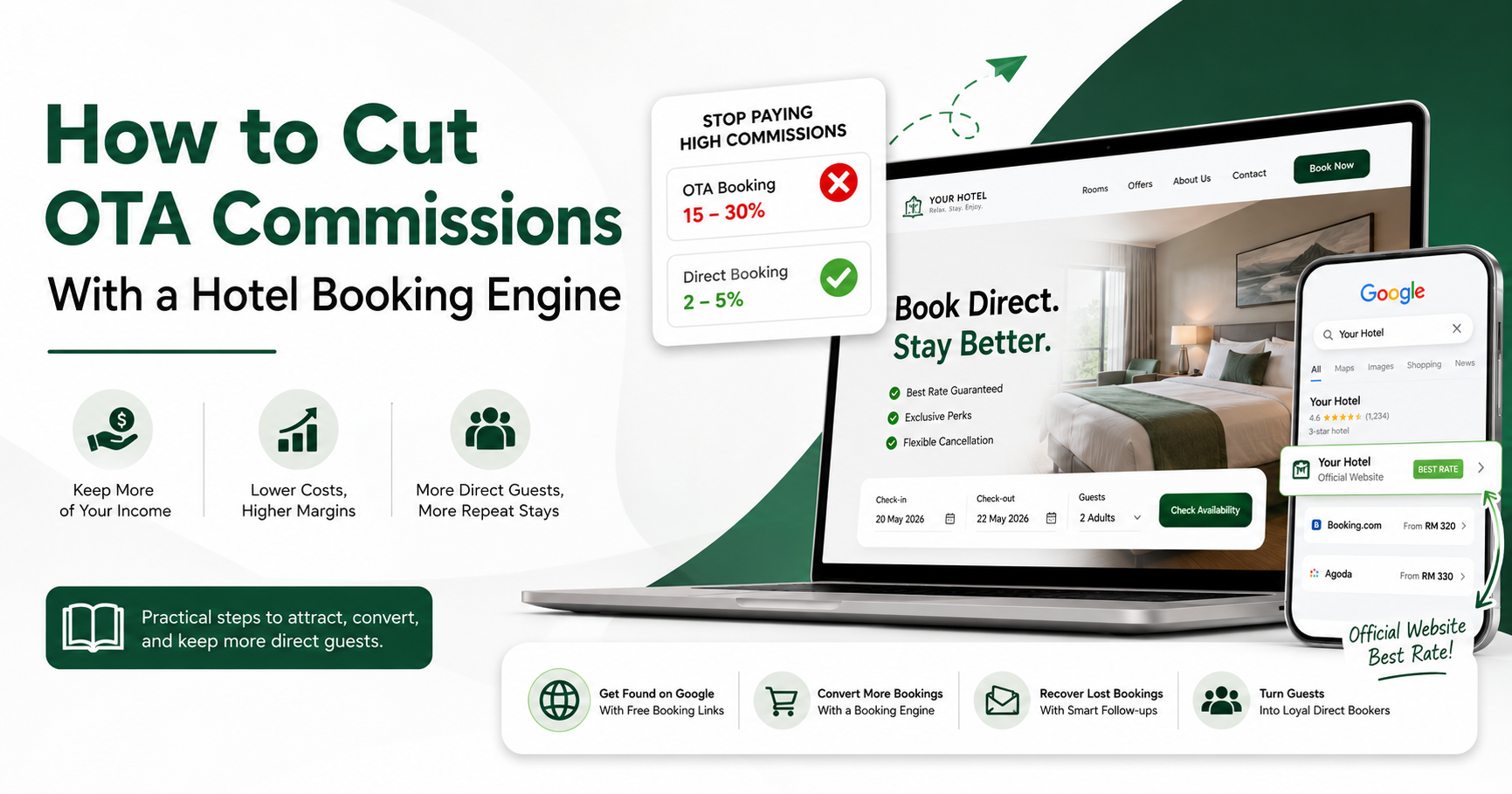
OTAs bring you guests. They also quietly take a big slice of every room you sell. For a small hotel running on thin margins, that slice is often the difference between a good month and a flat one.
The good news: you do not need to fight OTAs to win back margin. You need one asset that most small hotels still do not have, a hotel booking engine wired to your website and to Google. This guide walks you through it step by step.
How do you cut OTA commissions?
Quick answer: Add a booking engine to your website so guests can book you directly, list your real-time rates on Google Free Booking Links (which cost zero commission), make your direct rate the best value, and turn OTA guests into repeat direct bookers. Done well, you move bookings from a channel that costs 15 to 30 % down to one that costs around 2 to 5 %.
How much are OTA commissions really costing you?
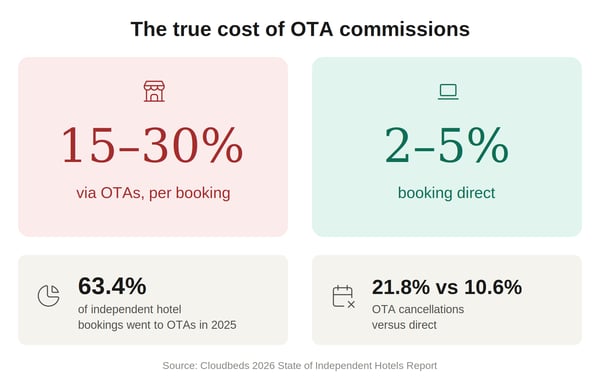
More than the headline number. Most OTAs charge between 15 and 30% per booking, and in Asia, Agoda often sits at the higher end, up to around 25%. Once you join "preferred" or sponsored placement programs, the effective rate can climb past 25 percent.
And the dependence is growing, not shrinking. Cloudbeds' 2026 State of Independent Hotels report found OTAs accounted for 63.4% of independent hotel bookings in 2025, up from 61% a year earlier, reaching close to 80% in some markets.
There is a quality gap too. That same report found OTA bookings were cancelled at 21.8%, more than double the 10.6% cancellation rate of direct bookings. So the commission is not the only cost. OTA revenue is also less reliable.
By comparison, a direct booking through your own site costs roughly 2 to 5% once you account for payment processing. Direct guests also tend to be worth more over time, booking higher room types and coming back.
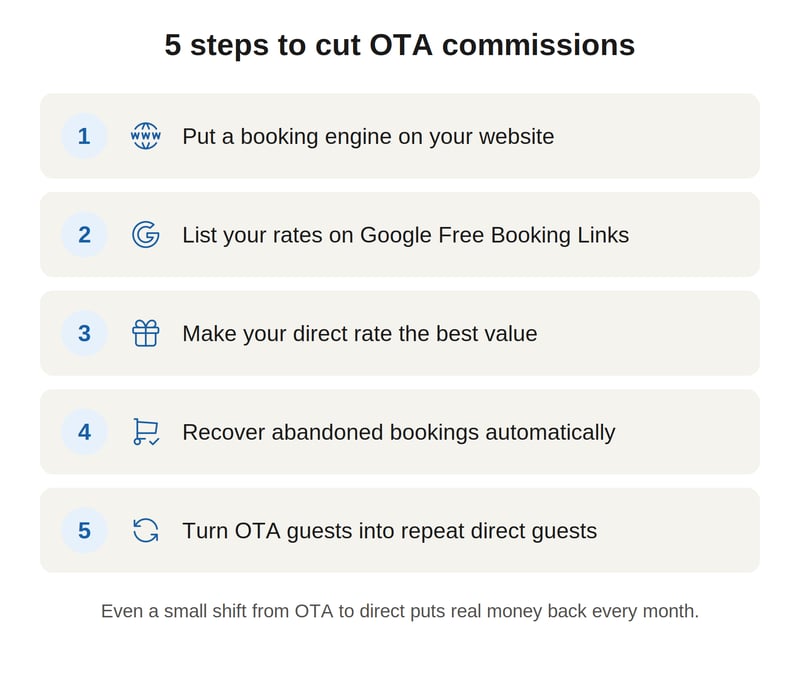
Step 1: Put a booking engine on your website
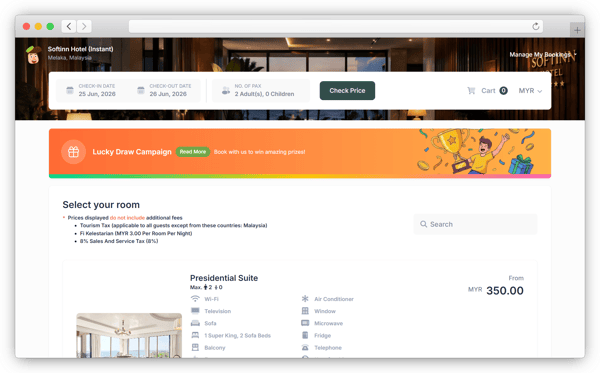
A booking engine is the "Book Now" system on your own website that lets guests check availability, pick a room, and pay you directly, with no middleman taking a cut.
Without one, your website is a brochure. A guest reads about your hotel, then leaves to book on an OTA anyway, and you pay commission on a guest who was already looking at you. With a booking engine, that same guest completes the booking with you.
Look for a booking engine that is mobile friendly (around 75% of travel bookings now happen on mobile), supports local payment gateways, and syncs with your channel manager and PMS so your rooms never double sell.
If you are still comparing options, our guide to the best hotel booking engines breaks down what to check before you commit.
Step 2: Get on Google with Free Booking Links
This is the biggest free lever most small hotels miss.
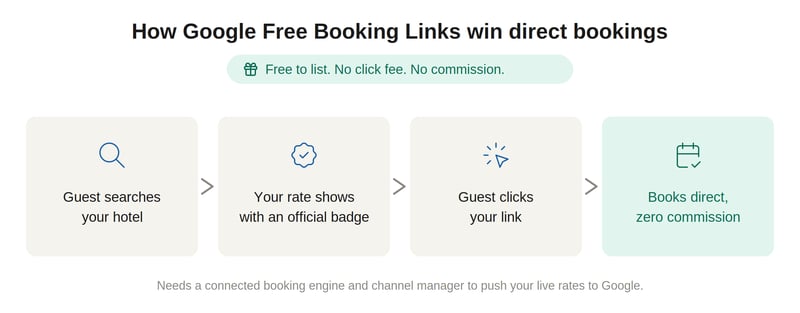
Google Free Booking Links show your own booking rate and availability directly inside Google Search, Google Maps, and Google Travel, listed right next to the OTAs, with an "official website" badge. When a guest clicks it, they land on your booking engine and book with you. There is no click fee and no commission.
Here is why this matters: over a billion travelers use Google to research hotels every month. When someone searches your hotel by name, the OTAs are already there with their link. If you are not, you are handing that guest to a commission channel for free.
To appear, you need a booking engine and channel manager that push your live rates and availability to Google. That is the whole setup. Softinn was in fact the first company in Malaysia that Google approached to connect hotels through the Google Hotel Booking Link, so this is built into how our booking engine works.
Step 3: Make your direct rate the best value
Getting the click is not enough. When a guest compares your direct rate against the OTA rate side by side on Google, you need to win that comparison.
You do not always have to be cheaper. You have to be better value. OTAs cannot offer what you can offer on your own channel:
- A small direct-only perk (free breakfast, late checkout, welcome drink)
- Flexible cancellation
- Room upgrades at your discretion
- A personal touch OTAs simply cannot match
Rate parity rules that once forced hotels to match OTA prices have been loosening, which gives you more room to reward guests who book direct. Use that room. Sell the outcome, not just the price.
Step 4: Recover the bookings you almost lost
Most guests who start a direct booking do not finish it on the first try. Softinn's own booking engine data shows that 85.5 % of guests did not pay after adding a room to the cart.
That is not lost revenue. That is revenue waiting for a nudge. A booking engine that automatically follows up with those guests recovers bookings you would otherwise lose, again with no commission attached. This one feature alone can pay for the whole system.
Step 5: Turn OTA guests into repeat direct guests
You will never drop OTAs to zero, and you should not try. OTAs reach travelers you cannot reach alone. The smart play is to let the OTA win the first booking, then win every booking after that yourself.
When an OTA guest stays with you, capture their email, give them a great stay, and invite them to book direct next time. This is where the "billboard effect" finally works in your favor. The guest discovered you through the OTA, but the repeat business, the profitable, loyal, low-cancellation business, comes straight to you.
For more on balancing the two channels, see our post on OTAs vs direct booking and which one brings more profit.
Where I stand on this
I believe most small hotels are not overpaying OTAs because OTAs are unfair. They are overpaying because they never built the one asset that makes direct booking possible: a booking engine connected to Google. An OTA listing without a direct booking channel behind it is a hotel paying rent on its own guests.
Softinn's position is simple and practical. We do not think you should declare war on OTAs. We think you should stop paying commission on the guests you have already earned, the ones who searched your name, the ones who stayed before, the ones who were always going to book you anyway. Fix that, and the commission line shrinks on its own.
Your practical takeaway
You do not need a big marketing budget to cut OTA commissions. You need three things working together:
- A booking engine on your website
- Your live rates showing on Google Free Booking Links
- A direct rate that is genuinely worth choosing
Start there. Even shifting a small share of bookings from OTA to direct puts real money back in your pocket every single month.
Here is a practical playbook to attract, convert, and keep more direct guests without slashing your rates. Written for independent hoteliers, no fluff, for growing commission-free bookings.
Frequently asked questions
-
Is a hotel booking engine worth it for a small hotel?
-
Yes. A booking engine lets you take direct bookings at around 2 to 5 % cost instead of paying OTA commissions of 15 to 30 %. For a small property, that margin difference adds up fast, and direct guests cancel less often.
-
-
Do Google Free Booking Links really cost nothing?
-
Yes. Free Booking Links show your rates on Google at no click fee and no commission. You only need a connected booking engine and channel manager to push your live availability to Google.
-
-
Should I stop using OTAs completely?
-
No. OTAs help travelers discover you. The goal is not to abandon them, it is to move the bookings that should be direct (repeat guests, brand searches) off the commission line.
-
-
How quickly can I see results?
-
Once your booking engine is live and your rates are on Google, you can start capturing direct bookings immediately. Cart recovery and repeat-guest campaigns build on top of that over the following weeks.
-


Tai Pei Shi
Hi, I am Pei Shi. I am a Technopreneurship student and digital marketing intern in Softinn.
Comments
Recent Posts
When the Minimum Wage Goes Up, What's Your Hotel's Next Move?
Why Hotels Should Offer Reserve Now, Pay Later to Guests
API, AI, Integration: Should Your Hotel Build or Buy?
The Best AI Preparation Your Hotel Can Do Has Nothing to Do With AI
The e-Invoice Exemption Increased to RM3Million : What It Means For Your Hotel?