
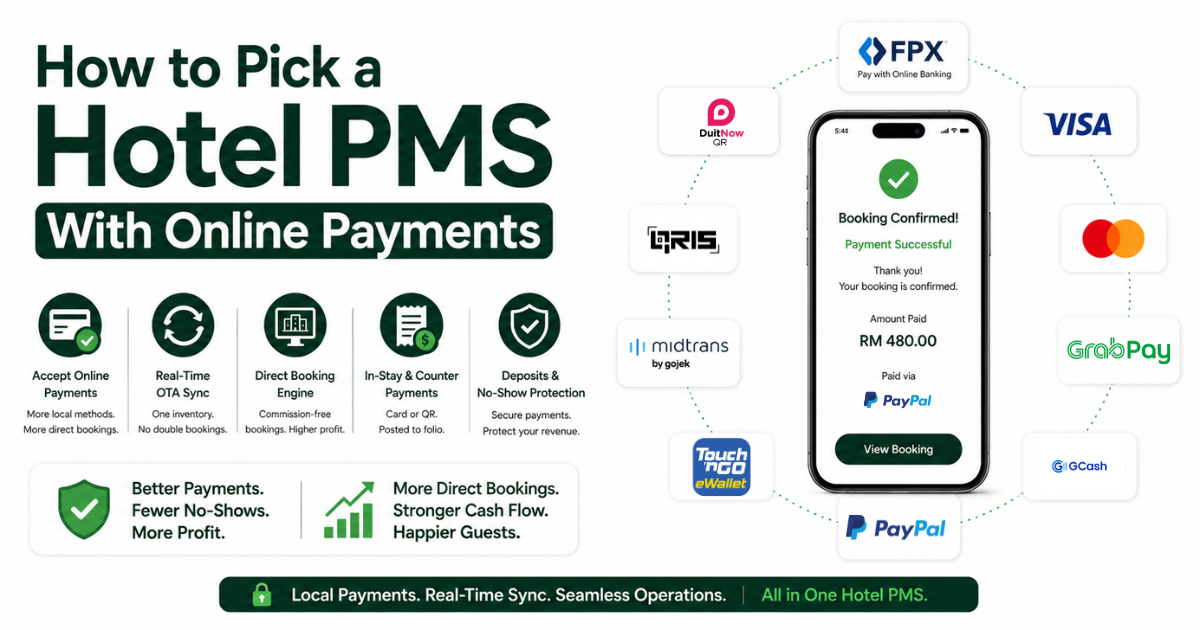
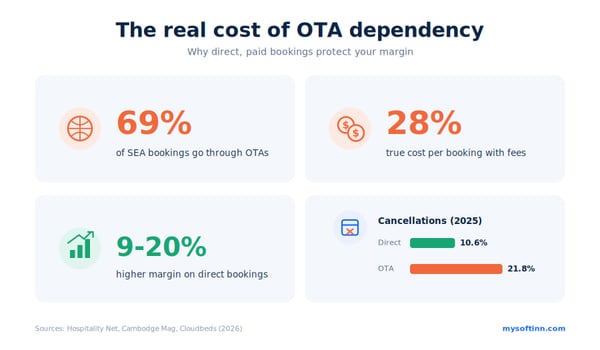
Running a small hotel in Southeast Asia means living with a hard truth: most of your guests arrive through an OTA, and each one takes a cut. Across the region, online travel agencies capture roughly 69% of bookings, and in Malaysia that figure peaks at about 57%. Headline commissions look like 15%, but once hidden fees stack up, the real cost can climb toward 28%.
At the same time, your guests have changed how they pay. In Malaysia, cash at the point of sale dropped from 64% in 2019 to just 22% in 2025, and DuitNow QR now has more than 2.6 million acceptance points. Guests expect to book and pay online, in the method they already use. In addition to paying for their room, guests increasingly prefer to order services—such as room service and food—and pay using their mobile phones.
So the property management system you choose is no longer just a front desk tool. It is where bookings, payments, and cash flow either come together or fall apart.
The short answer
A good hotel property management system with online payments should do four things well:
- Collect payment online at the moment of direct booking, through your booking engine.
- Sync rates and availability with OTAs in real time.
- Manage the guest folio and collect payment in-stay and at the counter, by card or QR.
- Handle deposits, prepayments, and no-show charges automatically.
If a system cannot do all four, it will keep leaking money and staff time. The rest of this guide explains what to check before you commit.
First, know the two payment moments
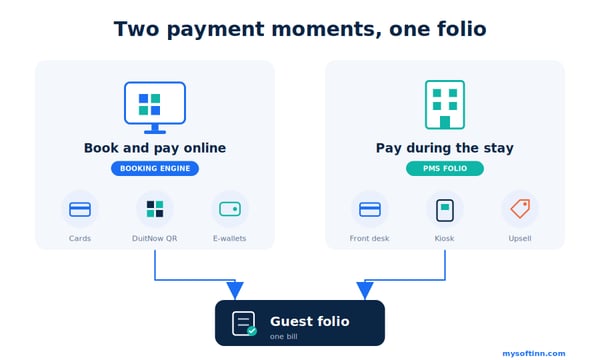
This is where most buyer guides get sloppy, so let me be precise. A hotel collects money at two different points, and they are handled by two different parts of the system.
1. Online, before arrival (your booking engine). When a guest books on your website, the payment is taken by your booking engine through a connected gateway. This is where local payment methods, prepayment, and no-show protection matter most.
2. In-stay and at the counter (your PMS folio). Deposits, room service, add-ons, extensions, and final checkout are posted to the guest folio inside the PMS. Payment here happens at the front desk, at a kiosk, or through a QR the guest scans.
A PMS with online payment gateway is only useful when these two moments connect. A booking paid online should flow straight into the folio, and an in-stay charge should settle without anyone re-keying a card.
Why connected payments matter now
When the booking engine and PMS share one payment flow, a paid booking updates the guest folio, invoice, and payment record on its own. There is no chasing card details at check-in.
The operational payoff is real. Hotels that integrate payments into their systems report administrative cost reductions of 20% to 40% and cut reconciliation time by up to 70%. That is time your front desk gives back to guests instead of spreadsheets.
There is a revenue angle too. Direct bookings carry profit margins 9% to 20% higher than OTA bookings, and they cancel far less often: in 2025, about 21.8% of OTA bookings were cancelled versus 10.6% of direct bookings. Every direct, prepaid booking is a more reliable booking.
What to look for in a hotel PMS with online payments
Use this as your buyer checklist. These are the hotel management tools that separate a system that helps your business from one that just stores reservations.
1. Local payment methods at online checkout
Southeast Asia does not run on international cards alone. Digital wallets took 26% of e-commerce and 32% of in-person payment value in Malaysia in 2025. In the Philippines, GCash alone serves about 94 million users.
Your booking engine checkout needs integrated payment solutions that cover the rails your guests use: local cards, FPX and DuitNow QR in Malaysia, QRIS in Indonesia, PromptPay in Thailand, and popular e-wallets across the region. If checkout only offers foreign cards, you will lose the booking at the final step.
2. Real-time OTA sync
Double bookings usually happen when your channel manager, PMS, and payment gateway do not talk to each other fast enough. Two guests, one room, and a one-star review to clean up. Choose a system where a booking on any channel updates availability everywhere, instantly.
3. A direct booking engine that fits
This is where you win back margin. Your hotel booking software should include a booking engine that takes payment directly on your own site, commission-free, and pushes the reservation straight into your PMS. Think of it as the Direct Booking Path: traffic to your site, a clear offer, then a smooth paid conversion. Get all three right, and you shift bookings away from the OTA tax.
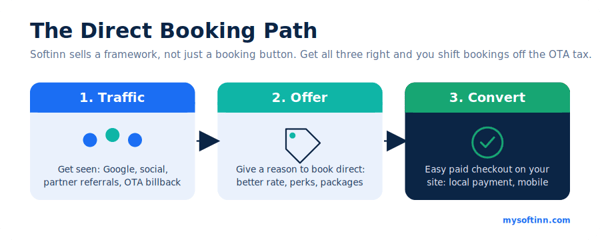
Softinn's traffic → offer → convert framework for growing commission-free bookings.
4. Deposit and no-show protection
Card tokenization lets you securely store payment details to charge deposits, prepayments, or no-show fees later. For a small hotel, protecting even a few no-shows a month covers real revenue.
5. In-stay QR payments that lift up-sell
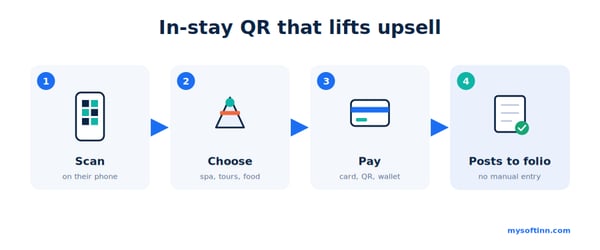
This is the point most owners overlook. Your hotel operations software should let guests pay for extras during their stay through a QR they can scan, with the charge posting straight to their folio. Spa, day tours, airport transfers, late checkout, and food orders are on-property revenue that small hotels leave on the table every day.
The trick is making it effortless to say yes. When the offer and a scannable payment sit in the same place, guests buy more, and your staff do not have to chase anyone for cash. Every add-on lands in the folio automatically, so checkout stays clean.
6. Simple enough for any front desk
The best system is the one your least tech-savvy staff member can run without calling for help. A clean, guided screen beats a feature-packed dashboard every time. Ask for a trial and let your actual front desk try it before you buy.
7. Recording transaction details
With a payment gateway integration, a PMS automatically records every payment transaction. The finance department uses these transaction records to reconcile hotel collections. Digitising this process eliminates hours of manual work that is often prone to human error. The resulting reports also help the finance and bookkeeping teams prepare accurate financial statements.
My honest take
I believe payments are not an add-on. They are the moment a booking becomes money in your account. If your system forces guests through a clumsy or foreign-only checkout, you lose the sale no matter how good the rest of the software looks. Choose the payment experience first, then check the operational features around it. I also believe you should stop measuring a PMS by how many buttons it has. Measure it by two numbers: how many direct bookings it helps you win, and how much staff time it gives back. then check
Where Softinn stands
Softinn is built for small and boutique hotels in Southeast Asia, so local payments are the default, not an afterthought. The Softinn booking engine connects directly to the PMS and supports local gateways such as Adaptis, eGHL, Billplz, Midtrans, Doku, Paysys, PesoPay and PayPal, so guests pay the way they already pay. Direct bookings are commission-free, availability syncs across OTAs automatically, and web check-in has helped our hotels cut front desk queue time by around 65.7%.
In-stay, the Softinn PMS guest folio tracks every charge and payment, lets you check outstanding balances at a glance, and sends e-invoices and e-receipts in one click. At the counter, FATboy collects card payment and can issue a QR room key. At the self-service kiosk, guests pay by card or QR, and the idle screen doubles as upsell space for day tours, spa, and dinner sets, with every payment posting back to the folio.
We would rather sell you a working system than a longer feature list. That is why we offer a try-before-you-buy trial: test it with your own team before deciding.
Not sure what to look for in a system?
We built a ready-to-use PMS Comparison Scorecard (Excel) and a PMS Demo Question Checklist so you don't have to start from scratch.
Practical takeaway
Accepting digital payments is not an option but a must for any business. Investing in a PMS that integrates with a digital payment solution not only helps the hotel with payment collections, but also helps it digitise its business.
Do not choose a hotel property management system on price alone. Score it on payments across the whole journey: local methods at online checkout, real-time OTA sync, a commission-free booking engine, automatic deposit handling, and in-stay QR payments that post to the folio and lift your upsell.


Tai Pei Shi
Hi, I am Pei Shi. I am a Technopreneurship student and digital marketing intern in Softinn.
Comments
Recent Posts
How to Pick a Hotel PMS With Online Payments
How PMS Prevents Hotel Overbookings in 2026
Hotel Management Systems for Airbnb Hosts in 2026
9 Cloud Hotel System Facts for Small Hotels
How to Compare Hotel PMS for Small Hotels in 2026 (A Practical Guide)