
A cloud hotel PMS fits your small hotel when it removes your most repeated daily work, runs on the staff and budget you already have, and grows with you. The question in 2026 is no longer whether to move to the cloud. It is whether a specific system fits your property. Below are eight signs, drawn from what we see across the 2,000+ hotels running Softinn in Malaysia and Southeast Asia, that tell you a cloud-based hotel management system is the right move now, not a nice-to-have later.
A quick definition first. A cloud-based hotel management system is a hotel property management system that runs online through a web browser, instead of on a server sitting in your back office. If you want the full fit, budget, and migration walkthrough, start with our guide to cloud hotel systems for small hotels in 2026.
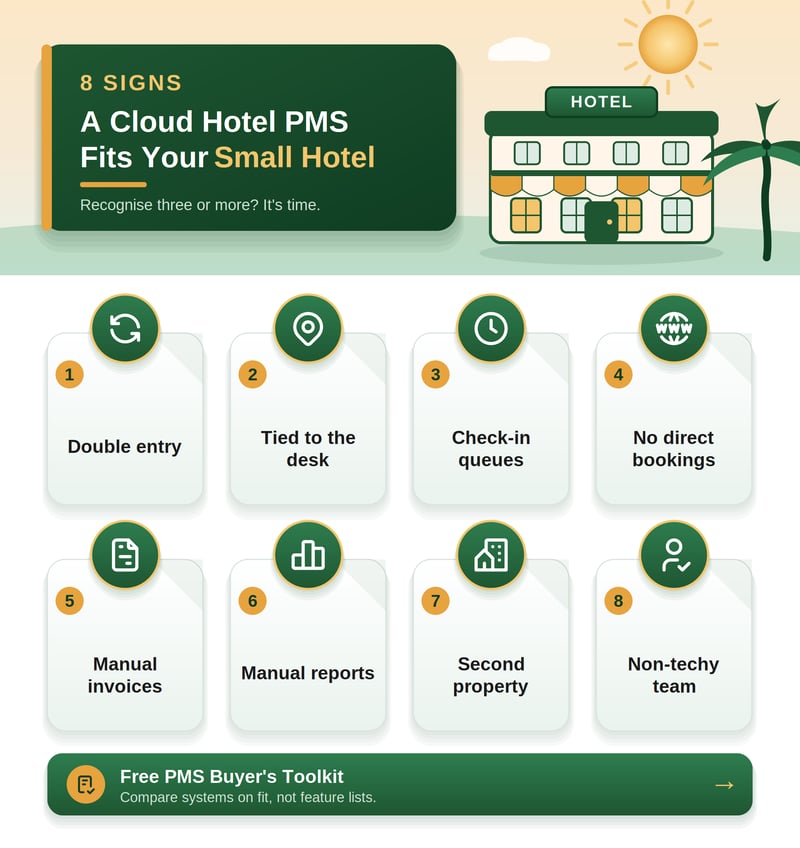
Sign 1: You update the same booking in more than one place

You change one rate, so you log into Agoda, then Booking.com, then a spreadsheet, then the front desk diary. Every manual update is a chance to forget one channel and sell a room you no longer have.
This is the clearest sign a cloud PMS fits you. A cloud PMS connected to a channel manager syncs your rooms and rates once, across every OTA at the same time. Across the 2,000+ hotels running Softinn, 49.76% connect their PMS directly to a channel manager, and the pattern is consistent: hotels that automate distribution spend less time on manual updates and less time fixing overbookings. The more OTAs you sell on, the more places a manual rate change can go wrong, and manual distribution simply does not scale past a handful of channels.
Read also: 8 OTA Integration Facts for Cloud Hotel PMS.
Sign 2: Operations wobble the moment you leave the property
If you cannot check today's arrivals, adjust a rate, or answer a booking question unless you are physically at the front desk computer, you are running on-premise thinking.
A cloud system lives online, so you can manage the property from the front desk, from home, or on the road. Your data is backed up automatically and updates happen on their own. A traditional on-premise system ties you to one machine and one location. I believe the freedom to run your hotel from your phone is the upgrade owners underrate most. It is not a luxury. It is what lets a small team take a day off without operations falling over.
Sign 3: Check-in is your daily bottleneck
Every afternoon a queue forms at the front desk, guests wait, and one receptionist juggles arrivals, phones, and questions at once.
Automated check-in, digital folios, and clean billing take real pressure off a lean team. For hotels with sharp arrival peaks, a self-service kiosk has cut front desk queue time by 65.7% at the properties we measured. The kiosk is a separate product that connects to the PMS, so you can add it when the queue justifies it, not before. If the busiest hour of your day is check-in, a cloud PMS that automates the routine parts fits you.
Sign 4: You want more direct bookings but your website cannot take them
Guests find you, like what they see, then hit a page that cannot actually take a booking, so they go back to the OTA, and you pay commission on a guest you already earned.
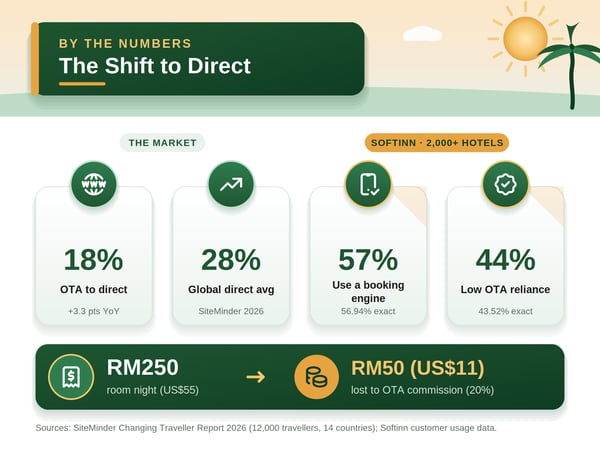
The demand is shifting your way. SiteMinder's Changing Traveller Report 2026, based on 12,000 travellers across 14 countries, found that 18% of guests who start on an OTA end up booking directly, up 3.3 points year on year, with the global direct booking average now around 28% and more than half of research happening on a phone. To capture that, you need a booking engine and a website working together in real time. Hotels running Softinn now 56.94% use a booking engine and 43.52% now operate without heavy OTA reliance. The maths is plain: on a RM250 (about US$55) room night, a 20% OTA commission is RM50 (about US$11) gone before you have paid for housekeeping.
Free resource: PMS Buyer's Toolkit →
A ready-to-use PMS Comparison Scorecard (Excel) and a PMS Demo Question Checklist, so you can judge fit instead of feature lists. Download the PMS Buyer's Toolkit for free.
Sign 5: You still issue invoices by hand, and e-invoicing is now the law

In Malaysia, LHDN e-invoicing is now mandatory for most operating hotels, though the first year is a soft-landing.
Phase 4 brought businesses with turnover between RM1 million and RM5 million into the MyInvois system from 1 January 2026, with a relaxation period through 2026 during which LHDN holds back penalties for hotels making a genuine effort to comply. Properties below RM1 million are exempt following the December 2025 policy update, which raised the exemption floor from RM500,000 to RM1 million and scrapped the planned phase for the smallest businesses. If you are near the RM1 million line, or you supply a larger company, it is still worth preparing early. Add SST at 8% on top, and manual invoicing becomes a compliance risk, not just a chore.
A cloud PMS with built-in e-invoicing and e-receipts handles the format, the submission, and the record-keeping inside your normal check-out flow. If you are still typing invoices by hand, local compliance alone is a sign the fit is there.
Sign 6: Your dashboard is a spreadsheet you update by hand
If the only way to see last month's occupancy, average rate, or booking source mix is to open a spreadsheet and add it up yourself, you have a visibility gap.
A cloud PMS gives you daily performance you can read at a glance: who is arriving, what you sold, and where the booking came from, without spreadsheet archaeology. I believe you cannot improve what you cannot see, and most small hotels are flying with far less information than their system could hand them for free. In our own onboarding, the booking-source mix is the report owners react to most; it is routinely the first time they see how much of their business actually depends on one OTA. Clear reporting is what turns a hunch into a decision. For how the reporting layer connects to the rest of your stack, read all you need to know about the hotel front office system.
Sign 7: You are planning a second property
If you started with one hotel and now have your eye on a second branch, your software choice today decides how painful that growth is tomorrow.
Cloud systems scale without new servers or new installs at each site. A subscription model means you add a property, not a data centre. This is squarely the kind of operator a cloud PMS fits: one hotel today, ambitions for more. Picking a system that supports multiple properties from the start saves you a migration later. Our guide on Hotel Management Systems for Airbnb Hosts in 2026 covers the criteria that matter when growth is the goal.
Growth does not always mean buying the second hotel yourself. Some operators scale by managing units for other owners, and that brings its own monthly headache: splitting revenue and expenses with each owner. Softinn's PMS has a built-in profit-sharing system that auto-calculates the agreed split, say 70:30 between owner and operator, so every owner gets a clear statement and you skip the payout spreadsheet. If co-hosting is your growth path, see how Softinn handles owner management and profit sharing.
Sign 8: Your team is not techy, and training time is short
Your staff turn over, your best receptionist is also your best housekeeper's cover, and nobody has a spare afternoon for a complicated system.
This is the sign people ignore, and it is one of the most important. The best cloud hotel PMS for a small hotel is the one your least tech-savvy team member can run after a short walkthrough. A powerful system your team quietly avoids is worse than a modest one they actually use. I believe ease of use is not a soft feature for a small hotel, it is the whole point, because a small team has no room for software that needs a specialist to operate. If simplicity matters to you, that is a fit signal, not a compromise. See 7 questions to ask before choosing hotel front desk software.
Where I stand
I believe the right cloud hotel system for a small hotel is the one that fits how you already run the property, sits inside a budget you can defend against real savings, and can be migrated without disrupting guests.
If you recognised three or more of the signs above, a cloud-based hotel management system is not a someday project for you. It is the fix for problems you are already paying for in staff hours, overbookings, and lost direct bookings. The test before you sign anything is simple: does this help my hotel run more predictably and more profitably? If a trial does not make that obvious, keep looking.
Free resource: PMS Buyer's Toolkit
Compare systems the practical way, with our PMS Comparison Scorecard (Excel) and PMS Demo Question Checklist. Download the PMS Buyer's Toolkit for free →
Frequently asked questions
-
What is a cloud-based hotel management system?
-
It is a hotel property management system that runs online through a web browser, rather than on a local server at the property. Because it lives in the cloud, updates and backups are automatic and you can manage the hotel from any device with an internet connection.
-
-
Is a cloud PMS worth it for a hotel with fewer than 20 rooms?
-
Yes. Subscription pricing and cloud delivery made a modern PMS realistic for 10 to 40-room properties by removing the server, the install, and surprise IT bills. The main requirement is a stable internet connection.
-
-
Do I need a channel manager and a booking engine as well as a PMS?
-
Not on day one, but most small hotels add them quickly. The PMS is the core; the channel manager syncs your OTAs and the booking engine takes direct website bookings. They are separate connected products, so you can start with the PMS and grow the stack as you go.
-
-
Will e-invoicing apply to my small hotel in Malaysia?
-
If your hotel's annual turnover is above RM1 million, you are inside the LHDN e-invoice mandate as of 2026, , with a relaxation period through 2026 before penalties apply. Properties below RM1 million are exempt following the December 2025 update that raised the exemption floor to RM1 million, unless you are a subsidiary or supplier of a larger mandated company. A cloud PMS with built-in e-invoicing handles submission inside your normal check-out flow.
-
-
What happens to my data if the internet goes down?
-
Your data lives in the cloud and is backed up, so it is not lost. You do need a reliable connection to work in real time, which is why a backup internet line is worth having.
-


Tai Pei Shi
Hi, I am Pei Shi. I am a Technopreneurship student and digital marketing intern in Softinn.
Comments
Recent Posts
Google AI Mode for Hotels: What Hotel Owners Need to Know
When the Minimum Wage Goes Up, What's Your Hotel's Next Move?
Why Hotels Should Offer Reserve Now, Pay Later to Guests
API, AI, Integration: Should Your Hotel Build or Buy?
The Best AI Preparation Your Hotel Can Do Has Nothing to Do With AI