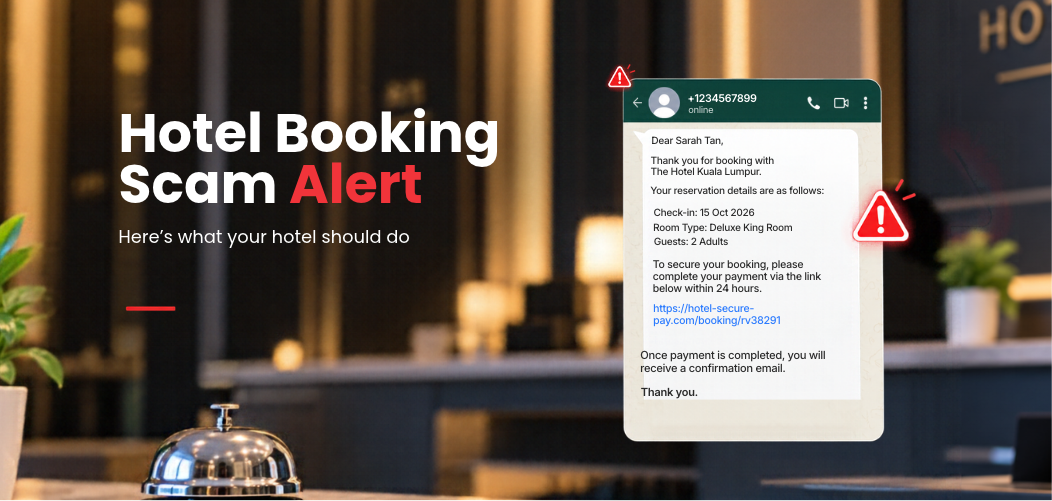
A guest WhatsApps your front desk: "Is this payment link really from your hotel?"
They forward the message. It has their real name, their real check-in date, the room type they booked.
Your hotel never sent it.
This is how hotel booking scams work now. And when it happens, the guest doesn't call the OTA or the police first. They call you. Whether your hotel looks careless or trustworthy depends on what your staff say in the next two minutes.
This is already happening worldwide
Singapore police reported at least 148 hotel booking phishing cases this year, with losses of at least S$185,000. In October alone, hotel booking and PMS providers in Finland, France and Australia reported guest details being stolen and used in fake payment messages. Hotels using those systems had to warn their own guests.
Malaysia isn't immune. In early November, the national cyber threat level was raised to medium, and Malaysia Airlines warned customers that booking data processed through Amadeus, its reservation provider, may have been affected. That's the same kind of system hotels rely on: Amadeus also supplies technology to around 2 million hotels. Most hotel cases here never make the headlines. We've dealt with some ourselves, alongside the hotels we work with.
With AI tools, scammers can now write convincing messages in any language and send them to hundreds of guests at once. Here's what to tell your guests, five habits to protect your hotel, and what to do if a guest reports a scam.
How do scammers get the real booking details?
This is the part that scares owners most. The guest's details are real, so the leak must be somewhere in the chain.
It's usually not a dramatic hack. More often, someone gets hold of a login that can see bookings:
- An OTA extranet login that was phished through a fake "Booking.com" or "Agoda" email
- A shared front desk password that five staff (and two ex-staff) all know
- A staff email or phone that's been compromised
Once they're in, they can see who's arriving, when, and how to contact them. Then they send the "verify your payment" message.
Our view: most of this risk sits in everyday habits at the hotel, not in fancy IT. Which is good news, because habits are something you can fix this week.
First, know what to tell your guests
Before any system changes, make sure every front desk staff can answer the question from the opening. Save this as a quick reply in WhatsApp Business:
Hi [Name], thank you for checking with us first. That message is not from [Hotel Name]. Please don't click the link or share any card details. Your booking with us is safe and confirmed for [date]. If you have any questions about payment, call us directly at [hotel number].
Then stop the question before it's asked. Add one line to your booking confirmation, your WhatsApp greeting, and your website:
[Hotel Name] will never ask you to verify your payment through a link sent by WhatsApp or SMS.
A guest who has read that line is much harder to fool.
If your hotel does send payment links, change the line to say exactly where real links come from, for example "only from [your booking page address]".
5 habits that close the door
1. One login per person. No more shared passwords.
If the whole front desk uses one password, you can't tell who did what, and you can't lock out one person without locking out everyone. Give each staff their own account in your PMS and OTA extranets.
2. Turn on 2-step login wherever you can
With 2-step login (also called 2FA), a stolen password alone isn't enough. The person also needs a code from the staff's phone. Booking.com, Agoda and most business email services offer it. Switch it on today.
3. Give staff only what their job needs
Does housekeeping need to see guest phone numbers? No. They need room status and their task list. The fewer people who can see guest details, the fewer places a leak can start.
4. When staff leave, their access leaves the same day
This is the one most small hotels miss. Add it to your resignation checklist: PMS, OTA extranets, email, WhatsApp Business, door lock system. Once a month, look at your active user list and ask: does everyone here still work for us?
5. Never log in through a link in a message
Scammers send fake "Agoda" or "Booking.com" alerts to hotel staff too. Urgent tone, a login button, a page that looks real. Teach staff one rule: go to the extranet from your saved bookmark, never from a link.
If a guest reports a scam message
Don't brush it off as "not our problem". Even if the leak didn't start at your hotel, the guest will remember how you handled it.
- Reassure the guest. Confirm their booking is safe and tell them not to click or pay.
- Ask for a screenshot of the message, including the sender's number or email.
- If they already paid, tell them to call their bank right away. In Malaysia, they can also call the National Scam Response Centre at 997.
- Tell the OTA if the booking came through one. They need to know their channel is being used.
- Change passwords and check your user list for the PMS and OTA extranets, in case one of your logins was the way in.
- Warn your other arriving guests with the line from earlier, before they get the same message.
Your move this week
- Save the guest reply as a WhatsApp quick reply
- Add the "we will never ask you to verify payment by link" line to your confirmations
- Check your PMS and OTA user lists and remove anyone who has left
Three small jobs, under an hour. Then share this post with your front desk team, because they're the ones who'll get that WhatsApp first.
Just because a message has the right booking details doesn't mean it's real.


Comments
Recent Posts
Hotel Phishing Scams Are Getting Smarter. Here’s What Your Hotel Should Do
Is Your Short-Term Rental Ready for Malaysia’s New STRA Guidelines?
Best Hotel Systems for Front Desk Teams in 2026
Who Really Owns Your Agoda Account? 7 Things to Lock Down Before Hiring a Revenue Manager
Hotel Wi-Fi PMS Integration: Give Every Guest Their Own Password, Automatically