
OTAs handled around 83% of hotel bookings across Asia-Pacific in 2025, and Agoda is now the region's largest, with a 20.9% share. For most boutique hotels in Malaysia, Thailand, or the Philippines, your Agoda (and OTA) listing is the single biggest door guests walk through.
So here's something worth checking: If you ended your revenue management contract tomorrow, could you still log in to your Agoda account?
For some owners, the answer is no. They hand the OTA side of the business to a revenue management company, the results look fine for a year or two, and then the relationship ends. That's when they discover the Agoda account is registered to the agency's email, the two-factor code goes to someone else's phone, and the listing they've built for years isn't really theirs.
At Softinn, we have seen many (not once) horror episodes of a revenue management company holding the hotel's OTA listing hostage. This isn't new; the news and stories are available online, on Google Reviews (of the management company), in blog posts, and discussed offline in meetings. On top of that, hotels reached out to us asking for help in many cases.
When occupancy slips and the OTA dashboard keeps showing red, outsourcing revenue management can look like the obvious fix. The pitch usually arrives at exactly that moment. A revenue management company spots a struggling property, shows a few charts comparing it with competitors, and promises a jump in bookings and ADR within months, often for a monthly fee plus a percentage of revenue.
For an owner who is already stretched across front desk, finance and maintenance, handing the problem to “the experts” feels like relief. Some partners deliver real results. Others overpromise, leaning on short-term tactics like deep discounts or heavy OTA promotions that lift bookings while quietly eroding margin, and the hotel only notices when the contract is up for renewal. The decision to outsource isn’t wrong in itself. But a hotel that signs out of desperation tends to skip the hard questions, such as how results will be measured, what happens if targets are missed, and who keeps control of the accounts and data once the agreement ends.
This isn't about revenue managers being the bad guys. Most are professionals who make hotels more money. It's about hotel OTA account ownership, and a few setup decisions that protect you no matter who you work with.
Why Your OTA account is An Asset, Not Just a Login
It's easy to think of Agoda YCS or the Booking.com extranet as just a tool, like a password to a software system. It's much more than that. Inside that account sits:
- Your reviews. Years of guest scores that took hundreds of stays to earn. Start a new listing and you start from zero.
- Your ranking history. Conversion, cancellation and review data that Agoda's algorithm uses to decide where you appear in search.
- Your content. Photos, room descriptions, policies and facility details.
- Your payout details. The bank account where OTA collections land.
- Your booking and guest history. The record of who stayed, when and at what rate.
Losing access can disrupt bookings, payments and day-to-day operations. Recovering it may also require time and additional verification.
How The Lock-in Happens
It rarely starts with bad intent. It usually starts with convenience during onboarding:
- The agency sets up or "cleans up" your listing and registers using its own company email.
- The primary admin login is changed to the agency's account manager, and your own user is downgraded or removed.
- Two-factor authentication is tied to an agency staff member's phone number.
- Payout or bank details are routed through the agency, often described as "easier reconciliation".
- The contract says nothing about who owns the listing when the agreement ends.
Each step feels harmless at the time. Together, they mean the agency controls the account and you only have the access it decides to give you. When the relationship ends on bad terms, that access becomes leverage: unpaid fees, a notice period, or simply a slow, painful handover.
7 Things to Lock Down for Hotel OTA Account Ownership
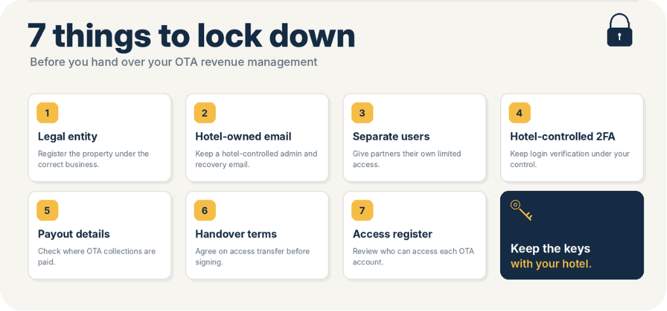 Run through this list before you sign with any revenue management partner. If you already have one, check it this week.
- Register the account to your legal entity. The property should be contracted with Agoda under your company name and registration (for Malaysian hotels, your SSM-registered entity), not the agency's.
- Use a hotel-owned email as the primary admin. Something like reservations@yourhotel.com, on a domain you control. Never an agency address, and never a staff member's personal Gmail.
- Give your partner a sub-user, not the master login. Agoda YCS and the Booking.com extranet both let you add users with their own logins. Your revenue manager gets their own access, which you can remove in minutes.
- Keep two-factor authentication on a hotel device. The verification code should go to a phone the hotel owns, not to someone outside the business.
- Keep payouts in your own bank account. OTA collections should land in your hotel's account. If an agency asks to route money through itself, ask why, and get it in writing.
- Put ownership and handover in the contract. Add a clause stating that all OTA listings, content, reviews and data belong to the hotel, and that the partner must hand over full access within a set number of days, for example 7, of termination for any reason.
- Keep a credentials record the owner controls. A simple access register: which channels you're on, who the primary admin is, and which partners have sub-user access. Review it every quarter.
Free resource: Want to get more out of your revenue strategy without giving up control? Download our Revenue Management Starter Kit for the essentials every independent hotel owner should know. Visit Softinn's resources page.
If You're Already Locked Out
Don't panic, and don't open a brand-new listing yet. Duplicate listings can get flagged, and you'd throw away your reviews. Instead:
- Ask in writing first. Email the agency requesting a full handover of admin access by a specific date. Keep it polite and factual.
- Gather proof of ownership. Business registration, property license or title, and any contract you have with Agoda.
- Contact the OTA's partner support directly. Explain that you are the property owner and request a change of account ownership. Each OTA has its own verification process, so follow their instructions exactly.
- Check your contract's termination clauses. If the agreement is unclear, or the agency is withholding access over a dispute, get advice from a lawyer before you escalate.
While you wait, make sure rates and availability are still under control, so you're not taking bookings at prices you didn't set.
Keep Control at the System Level, Too
The strongest protection isn't a contract clause. It's where your rates and inventory actually live.
-
When your hotel owns its PMS and channel manager, rates and availability flow out from your system to Agoda, Booking.com, Traveloka and your own booking engine. Your revenue manager works inside that setup with their own user access. If you change partners, you remove one user and add another. Your rates, your history and your channel connections stay exactly where they were.
Compare that with a setup where the agency runs its own tools and logs straight into your extranets. When they leave, they take the know-how and the access with them, and you're starting over.
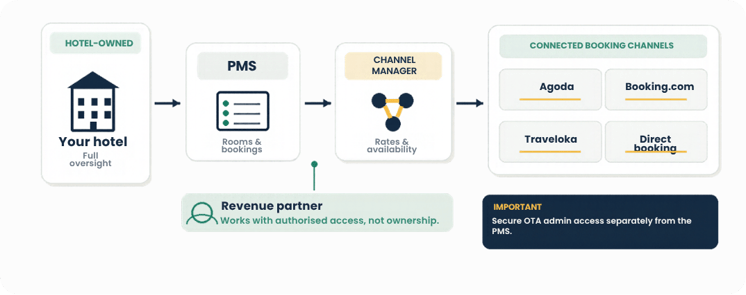
Softinn PMS and Channel Manager connect with your OTA listings. Hotel activities such as check-ins, check-outs and walk-in bookings help keep room availability updated across connected channels. With revenue reports, including RevPAR and its breakdown, hotel managers can also monitor performance and make more informed pricing decisions.
A Good Partner Won't Need All the Keys
Outsourcing revenue management can be a smart move, especially for a 30-room boutique property where the owner is also the GM, the marketer, and sometimes the night auditor. The right partner brings pricing expertise and market data you don't have time to build yourself.
But expertise and ownership are different things. A trustworthy revenue manager will happily work through a sub-user login, accept a clear handover clause, and leave your payouts alone. If a partner pushes back on any of the seven points above, treat that as useful information before you sign, not after.
Ask for sub-user access on day one. The right partner will say yes.


JeeShen
JeeShen is the CEO of Softinn, a SaaS company helping hotels run smoother and smarter. He’s not a professional blogger—just a tech and hospitality enthusiast who loves sharing thoughts, insights, and a few stories from the frontlines of the industry.
Comments
Recent Posts
Who Really Owns Your Agoda Account? 7 Things to Lock Down Before Hiring a Revenue Manager
Hotel Wi-Fi PMS Integration: Give Every Guest Their Own Password, Automatically
AI Won't Run Your Hotel. But It Can Help You Run It Better.
Google AI Mode for Hotels: What Hotel Owners Need to Know
When the Minimum Wage Goes Up, What's Your Hotel's Next Move?